

Why
is Stowey here?
It seems there were a number of influencing factors that together may have made Stowey a place to start a settlement.
Although it was a long time ago, I remember from my school days and geography lessons that the natural lie of the land has much to do with where settlements are established, so I started looking at what was here from very early times..
• Stowey is at the foot of the Quantocks with a route up and over the hills.
Stowey is at the foot of the Quantocks, and any early trade would have needed a route over or around the hills. Old trading routes and military paths (Herepath) were established from Saxon times and before.
One such was a route from Bristol that crossed the river Parrett to Combwich, where there was a natural causeway at low tide allowing horses and cattle etc to cross. This route then passed through Stowey and up over the hills, At the top it turned south to follow the ridge to Triscombe and then down to the valley beyond and onward over Exmoor, probably to Barnstaple.
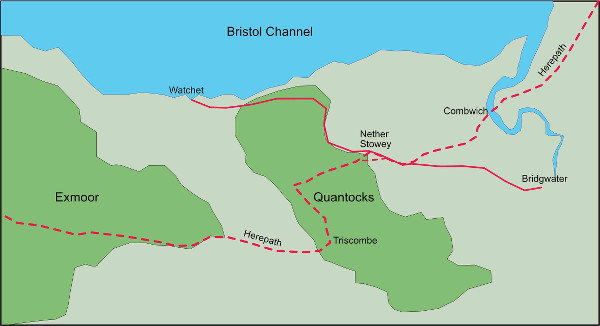
• Stowey is also on a direct route between the early natural harbour of Watchet and river crossing at Combwich and route to south via Brifgwater.
The natural ports along the north coast of Exmoor: Lynmouth, Porlock and Watchet, would have linked to the river crossing at Combwich via Stogursey, but also a route would have crossed through Stowey to Bridgwater and further on to the south of the river Parrett. These would have been important early trading routes and locations. The route that passed through what is now Nether Stowey was at the point where it joined with the Herepath or traders route over the hills, so Stowey was a natural meeting point of two main trading routes.
It is suggested that the route over the hills was stoney, and hence the name Stowey could have been a version of "Stoney Way", used as a description of the location where the routes linked up; but I am sure there are other explanations for the name.
• There is a natural water course, or brook which runs through the location.
The fact that there was the brook running through Stowey meant that there was watering and hence a suitable resting place for the horses and pack ponies before climbing the hills or, indeed, for resting after crossing the hills for those coming the other way. This might explain why Nether Stowey rather than the more direct high link via Over Stowey became popular.
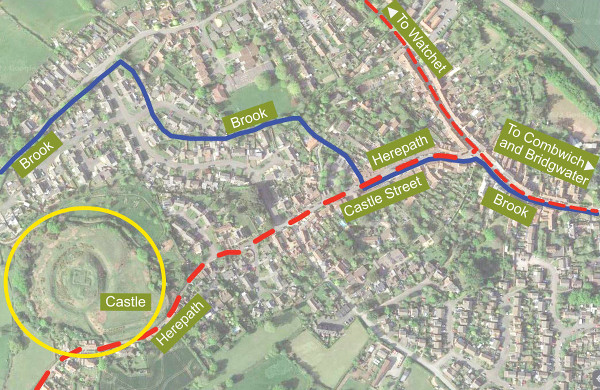
• There is a natural high look-out spot which became the site of a Norman motte and bailey castle.
Just on the west side of Stowey is a natural mount, or hillock. on which the Normans constructed a motte and bailey castle. The location has views over the coastline and Bristol channel, which made it ideal for looking out for possible invaders at different periods in the past.
I have also read that Archaeologists suggest that the Norman castle may well have been on the site of a more ancient iron age earthworks. If that is so, then some interest in the location would seem to have started a very long time ago.
• There were plenty of materials available for the early buildings:
Woodland on the hills would have provided the timber, both larger structural pieces as well as the smaller screen weaving elements.
Local farming activities would have provided the straw for thatching, as well as an element mixed with mud to form the daub for wattle and daub wall panels, and also for the more structural cob walls.
Local stone was probably there to just to pick up initially - it wasn't called 'stoney way' for nothing - and later numerous local small quarries around the hills were formed to provide stone for more substantial construction.
With this combination of routes and natural features, it is not surprising that the location might have been used as a meeting point as well as a resting stop for early traders.
This could have been supported by the local farm, which was probably in existence from very early days, long before what became 'Stowey Farm' which is known to have been active in medieval times. They could have supplied fodder for the horses as well as food for the traders who might set camp at the lower part of Castle street for the night.
It would follow from all this that some shelter and resting places for horses and people would have been erected, together with storage areas for fodder for the horses and also for the possibility of the start of some market trading activity at this junction.
It would not be surprising therefore if the beginnings of a settlement here could have developed at a very early stage. I believe that the early trading routes could have existed from two or three thousand years ago!
With the trading activities, Castle Street would have been a convenient area for gathering and resting of the trading traffic. The probable development of stabling and storage facilities could have been created leaving a working areas for wagons and horses loading or unloading beside the brook, so any buildings would have been set back from the brook to allow for this activity. This could explain the extra width of this section of the street being established early on during the development.
As the settlement developed around the passing trade and traders, there would have been the need for local trades like blacksmiths, leather workers, and then potteries and other services, which would have formed the necessary support for the activities of the traders. So workshops, storage and small dwellings would have started spreading out from the junction, which, I understand, later developed into a full scale market and trading centre.
In later years, the larger buildings in the village would have been built a result of these business and trading activities in the area, with many other smaller industries being part of the community. Stowey was probably a hive of activity for a few centuries. I have read that Stowey was considered a town a few centuries ago with a major market centred on the cross; its importance reaching a peak before declining as other locations took over the trading importance.
When a bridge was built crossing the river Parrett at Bridgwater in the 1200s, that centre was able to grow to take over much of the trading activities, and with different routes around the hills, the route over the hills via Castle street would have lost some of its importance, and the 'town' of Nether Stowey, would have become less important and changed more into the village we see today.
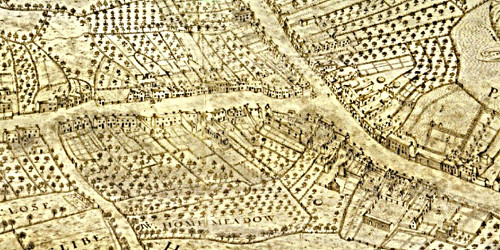
One only has to look at the map of 1750 (see above) to see that by that date, most of the main centre of Stowey was well established with buildings the full length of Castle street as well as the other main streets of the village, so the preceding medieval centuries were probably the time of major expansion for Stowey. It is only recently, since the 1900s, that the village has been growing again, but this time with the emphasis as a residential community.
Remember, all this is just my idea of how and why Stowey may have developed into the centre that it did, I may not be correct and there may have been other influences that affected the growth of Stowey. I would be happy to hear any other suggestions as to why Stowey is here at all!
I next want to look at how the buildings of Castle street may have started and the evolution of the buildings from early times which developed into a recognisable village street. If you're still with me, here are my thoughts on that...
....
I have found myself wondering how
long ago, and more particularly, why, did Stowey become a
settlement here at all.
I have read around the subject, but not really found many clear answers, so I have come up with my own thoughts on why Stowey may have started to be established here; they may not be correct, and I am happy to hear others' thoughts on the subject, but, this is what I have come up with....
I have read around the subject, but not really found many clear answers, so I have come up with my own thoughts on why Stowey may have started to be established here; they may not be correct, and I am happy to hear others' thoughts on the subject, but, this is what I have come up with....
It seems there were a number of influencing factors that together may have made Stowey a place to start a settlement.
Although it was a long time ago, I remember from my school days and geography lessons that the natural lie of the land has much to do with where settlements are established, so I started looking at what was here from very early times..
• Stowey is at the foot of the Quantocks with a route up and over the hills.
Stowey is at the foot of the Quantocks, and any early trade would have needed a route over or around the hills. Old trading routes and military paths (Herepath) were established from Saxon times and before.
One such was a route from Bristol that crossed the river Parrett to Combwich, where there was a natural causeway at low tide allowing horses and cattle etc to cross. This route then passed through Stowey and up over the hills, At the top it turned south to follow the ridge to Triscombe and then down to the valley beyond and onward over Exmoor, probably to Barnstaple.
• Stowey is also on a direct route between the early natural harbour of Watchet and river crossing at Combwich and route to south via Brifgwater.
The natural ports along the north coast of Exmoor: Lynmouth, Porlock and Watchet, would have linked to the river crossing at Combwich via Stogursey, but also a route would have crossed through Stowey to Bridgwater and further on to the south of the river Parrett. These would have been important early trading routes and locations. The route that passed through what is now Nether Stowey was at the point where it joined with the Herepath or traders route over the hills, so Stowey was a natural meeting point of two main trading routes.
It is suggested that the route over the hills was stoney, and hence the name Stowey could have been a version of "Stoney Way", used as a description of the location where the routes linked up; but I am sure there are other explanations for the name.
• There is a natural water course, or brook which runs through the location.
The fact that there was the brook running through Stowey meant that there was watering and hence a suitable resting place for the horses and pack ponies before climbing the hills or, indeed, for resting after crossing the hills for those coming the other way. This might explain why Nether Stowey rather than the more direct high link via Over Stowey became popular.
• There is a natural high look-out spot which became the site of a Norman motte and bailey castle.
Just on the west side of Stowey is a natural mount, or hillock. on which the Normans constructed a motte and bailey castle. The location has views over the coastline and Bristol channel, which made it ideal for looking out for possible invaders at different periods in the past.
I have also read that Archaeologists suggest that the Norman castle may well have been on the site of a more ancient iron age earthworks. If that is so, then some interest in the location would seem to have started a very long time ago.
• There were plenty of materials available for the early buildings:
Woodland on the hills would have provided the timber, both larger structural pieces as well as the smaller screen weaving elements.
Local farming activities would have provided the straw for thatching, as well as an element mixed with mud to form the daub for wattle and daub wall panels, and also for the more structural cob walls.
Local stone was probably there to just to pick up initially - it wasn't called 'stoney way' for nothing - and later numerous local small quarries around the hills were formed to provide stone for more substantial construction.
With this combination of routes and natural features, it is not surprising that the location might have been used as a meeting point as well as a resting stop for early traders.
This could have been supported by the local farm, which was probably in existence from very early days, long before what became 'Stowey Farm' which is known to have been active in medieval times. They could have supplied fodder for the horses as well as food for the traders who might set camp at the lower part of Castle street for the night.
It would follow from all this that some shelter and resting places for horses and people would have been erected, together with storage areas for fodder for the horses and also for the possibility of the start of some market trading activity at this junction.
It would not be surprising therefore if the beginnings of a settlement here could have developed at a very early stage. I believe that the early trading routes could have existed from two or three thousand years ago!
With the trading activities, Castle Street would have been a convenient area for gathering and resting of the trading traffic. The probable development of stabling and storage facilities could have been created leaving a working areas for wagons and horses loading or unloading beside the brook, so any buildings would have been set back from the brook to allow for this activity. This could explain the extra width of this section of the street being established early on during the development.
As the settlement developed around the passing trade and traders, there would have been the need for local trades like blacksmiths, leather workers, and then potteries and other services, which would have formed the necessary support for the activities of the traders. So workshops, storage and small dwellings would have started spreading out from the junction, which, I understand, later developed into a full scale market and trading centre.
In later years, the larger buildings in the village would have been built a result of these business and trading activities in the area, with many other smaller industries being part of the community. Stowey was probably a hive of activity for a few centuries. I have read that Stowey was considered a town a few centuries ago with a major market centred on the cross; its importance reaching a peak before declining as other locations took over the trading importance.
When a bridge was built crossing the river Parrett at Bridgwater in the 1200s, that centre was able to grow to take over much of the trading activities, and with different routes around the hills, the route over the hills via Castle street would have lost some of its importance, and the 'town' of Nether Stowey, would have become less important and changed more into the village we see today.
One only has to look at the map of 1750 (see above) to see that by that date, most of the main centre of Stowey was well established with buildings the full length of Castle street as well as the other main streets of the village, so the preceding medieval centuries were probably the time of major expansion for Stowey. It is only recently, since the 1900s, that the village has been growing again, but this time with the emphasis as a residential community.
Remember, all this is just my idea of how and why Stowey may have developed into the centre that it did, I may not be correct and there may have been other influences that affected the growth of Stowey. I would be happy to hear any other suggestions as to why Stowey is here at all!
....
I next want to look at how the buildings of Castle street may have started and the evolution of the buildings from early times which developed into a recognisable village street. If you're still with me, here are my thoughts on that...
....