

Castle Street - Nether Stowey
I have always appreciated the wide
variety of buildings in this street, which range from humble
cottages to impressive houses. This website follows my own
personal interest in, and curiosity about, the buildings of Castle
Street in Nether Stowey.
This website is my personal site and is not intended to be anything more than a record of my own inquisitive thoughts. I am not an expert in any of what I describe, just a curious individual. I quite accept that this may be of no interest to anyone else - that is fine - but I may as well use this website to record what I observe, discover and imagine. If others have any interest, suggestions for corrections to my thinking, or additions to my discoveries, please feel free to let me know, my email contact details are available at the bottom of this page.
INTRODUCTION
This page - scroll down
DESCRIPTION
A description of Castle Street for anyone who finds this site but does not know Nether Stowey.
WHY HERE
I look at why the village may have been established here at all.
HOW DEVELOPED
I look at the possible development through the ages of buildings on Castle street.
INDIVIDUAL BUILDINGS
The main section is where I look at each current building and, with the aid of old photos, maps and observation, see what can be deduced about the building's past.
BUILDING MATERIALS
Finally I look at the individual elements of the buildings - materials and building elements - walls, roofs, windows, doors, chimneys - for anyone who may have an interest!
This website is my personal site and is not intended to be anything more than a record of my own inquisitive thoughts. I am not an expert in any of what I describe, just a curious individual. I quite accept that this may be of no interest to anyone else - that is fine - but I may as well use this website to record what I observe, discover and imagine. If others have any interest, suggestions for corrections to my thinking, or additions to my discoveries, please feel free to let me know, my email contact details are available at the bottom of this page.
What does this website
contain?
INTRODUCTION
This page - scroll down
DESCRIPTION
A description of Castle Street for anyone who finds this site but does not know Nether Stowey.
WHY HERE
I look at why the village may have been established here at all.
HOW DEVELOPED
I look at the possible development through the ages of buildings on Castle street.
INDIVIDUAL BUILDINGS
The main section is where I look at each current building and, with the aid of old photos, maps and observation, see what can be deduced about the building's past.
BUILDING MATERIALS
Finally I look at the individual elements of the buildings - materials and building elements - walls, roofs, windows, doors, chimneys - for anyone who may have an interest!
------------------------------------------------------------
Introduction
I
am fortunate enough to be a resident of Castle Street, in the
village of Nether Stowey, which is at the foot of the Quantocks in
Somerset.
Like most villages, it has grown over the years, but the original central part of the village has a wide variety of buildings in a range of sizes and styles, in fact it is rare to see two buildings which are the same.
Castle street is one of the original central streets of this village which have a history going back many hundreds of years, Lime street and St. Mary street being the other original streets. They all meet at the cross, which is the central part of the village at the eastern end of Castle street.
Like most villages, it has grown over the years, but the original central part of the village has a wide variety of buildings in a range of sizes and styles, in fact it is rare to see two buildings which are the same.
Castle street is one of the original central streets of this village which have a history going back many hundreds of years, Lime street and St. Mary street being the other original streets. They all meet at the cross, which is the central part of the village at the eastern end of Castle street.

Castle Street, north side, eastern section
What we see when we walk down the street is, of course, just a snapshot of the built environment which, in many cases, has evolved over many years into what we see today.
I am also curious as to how Castle Street became what it is today, not just the present individual buildings, but also how the whole street may have been established and developed over centuries to become what it is today.
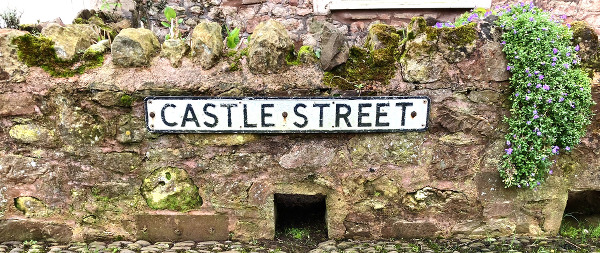
I will look at what is here today and see if there are any obvious clues as to changes that have occurred in the relatively recent past. Then track back with old photos and local knowledge as to how things have changed and developed since about 1900; before that, there needs to be an increasing amount of guesswork!.
We have photographs going back 100 years or more, and a few old maps, so we have some evidence of what Castle Street looked like in the relatively recent past. But what if we were to go back 250 or 500 years or more, what might we see? Are there any clues we can find that might begin to form a picture of how the street has developed from what may have been here say 500, 1000 or even more years ago?
Once I started thinking about it, so many questions came to my mind, I will try to find some answers.
We know that in the last 100 years, some properties have been demolished and new ones built in their place. But what more has happened which we do not have direct information about? How many of today's buildings were built on fresh land, and how many replaced older buildings before them?
Why did the village as a whole develop here in the first place?
Why is Castle Street so wide; was there an early reason for the width? This is interesting when you consider the comparison with adjoining Lime street, which is really quite narrow?
Was the brook which runs through the village always here naturally, or was it diverted here away from its natural route? If so, when?
I know archaeologists can give some indication of the past, but there must be so much that is either hidden from view, or has been destroyed as the street developed.
My interest is more from the practical reasons for what is here rather than any intellectual academic investigation. I have never really been interested in 'history' as such - ie kings, queens and battles etc - but my interest is more about 'how' and 'why' things developed in the way that they have. My interest covers why buildings were built here in the first place, and what materials were available at the time. and how they have changed through practical reasons of availability and cost of different materials through the years since.
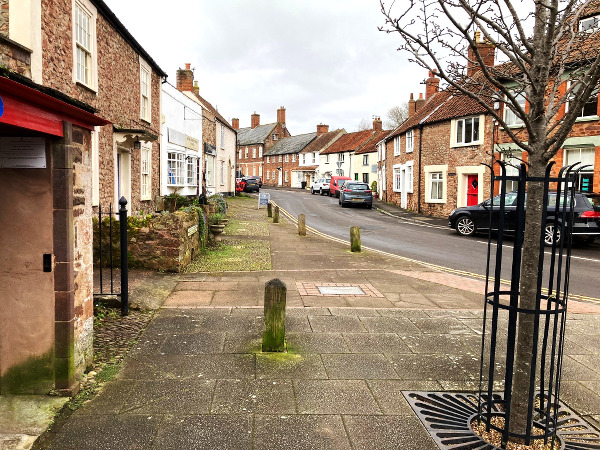
How much can we learn from the street view?
Looking at the present buildings here, there are sometimes a few clues as to how a building may have changed over recent years, but often clues are hidden from view.
Buildings change over time as different owners make alterations to suit what they want. Take our own cottage as an example: when we took over our cottage, it was in a sorry state and needed major renovations. As a consequence, what the passer by sees of our house now, differs from how it was when we arrived in 1990; and, in turn, that view was different from earlier that century.
I am aware that little of what was before is currently evident from the present exterior view from the street; this makes me wonder how much other properties have changed over the years which is not evident to the casual passer by today.
We are fortunate to have some knowledge of how our house has changed over the later years, but often wonder how it had changed over a longer period in the past. There are a few clues we have observed during the renovations, but these often raise more questions than they answer.
The same is probably true of many of the buildings in Castle street.
....
House or inhabitants - our house or their house?
House or inhabitants - our house or their house?
There have been some series on television called "A house through time", in which the historian, David Olusoga, takes a single house and, with much detailed research, follows those who have lived in that house through the years to discover their various events in life. I have watched these and recognise how the main character, the house itself, is the one relative constant that has experienced all those inhabitants.
This makes me even more aware that we are simply temporary custodians in our own houses with, often, many having lived there before us, and hopefully many after us, all of whom have, and will think of 'our' house as 'their' house.
Unlike 'A house through time', my interest is more on the building itself, and how it may have changed and evolved over time.
Old photographs credit
I must give credit to others for the old photographs I have included on this site.
I have 'borrowed' them from wherever I have found them on-line, including the Nether Stowey history Facebook group's resources; so thank you to all who have contributed them to that group and elsewhere.
Current photographs and illustrations are mine, unless otherwise credited.
General description of Castle Street
For those who don't know Nether Stowey, perhaps a general description
of Castle Street might help you know what I am going on about!
See here...
....