

How buildings in Castle street may have developed
Before we start, please be aware that I am no historian and the following is simply my own ideas of how the street may have become what it became. Please don't take anything as authoritative, these are simply the ramblings of my own ageing mind based on what I have read combined with my imagination! If anyone has more knowledgeable information, I would be happy to hear it!

Castle Street, north side, eastern section
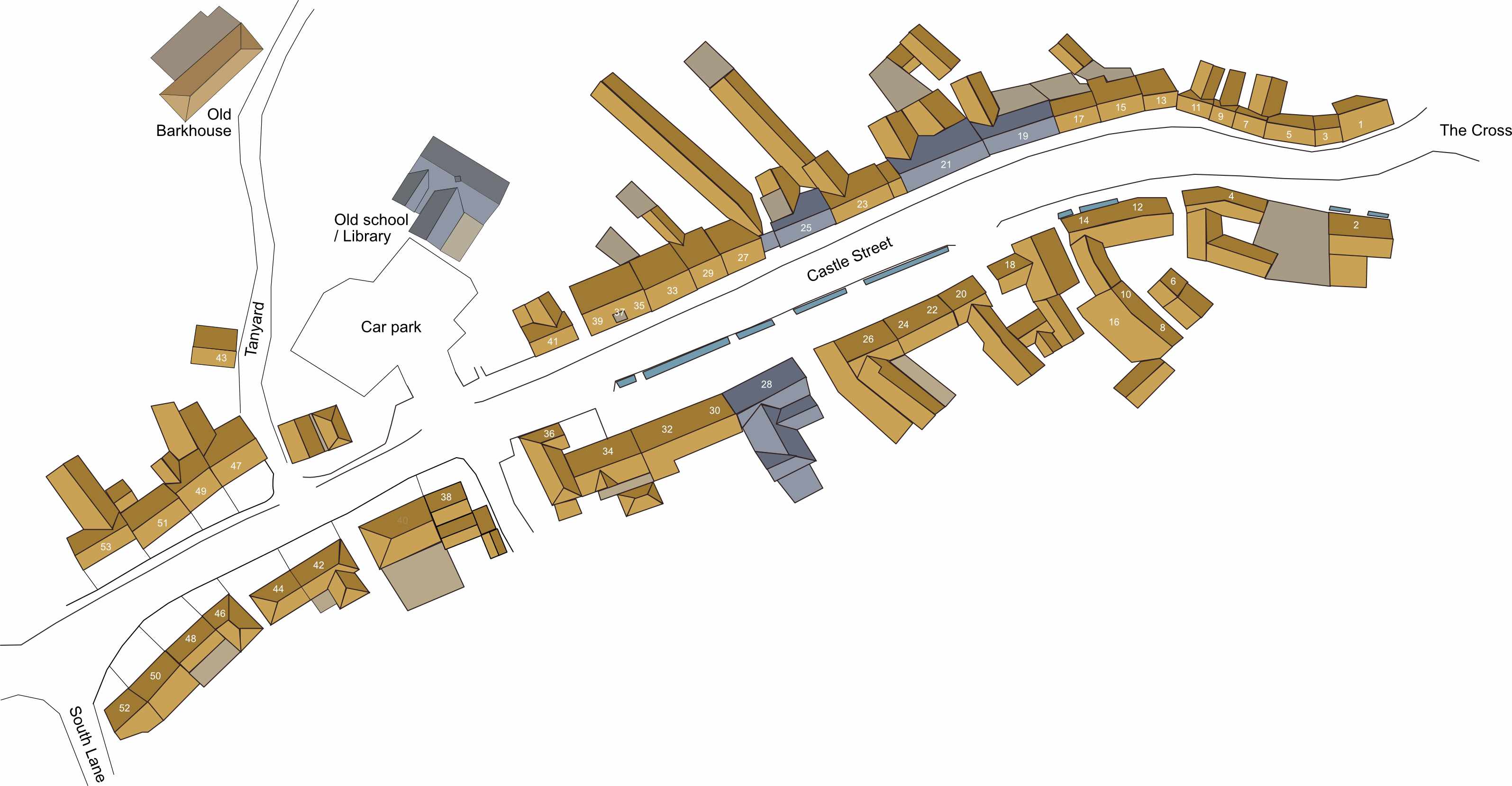
It would seem that most rural villages as such were unlikely to have
been established much before about the 1100s, often beginning as
expansions of farming locations. As far as I am aware, there is no
documented evidence of what buildings were here before 1100AD, so we
have to use our imagination to try and figure out what went on here
before that.
I have previously put forward my ideas of why the settlement may have developed here, so using those ideas as a starting point, we can imagine that during the dark ages, (ie post-Roman, pre-Norman) for several hundreds of years before the medieval period, some simple buildings would have gradually been established to serve the likely resting location for traders crossing the hills using the old trading routes.
Stowey may have had a collection of simple buildings which served as shelters and fodder storage etc for traders passing through, perhaps growing enough to be classed as a hamlet.
Any really early buildings would probably have been clustered around the junction which is now the cross rather than lined up what later became Castle street; the track and brook that led to the traders route over the hills would have been just that initially, only much later being lined with buildings.
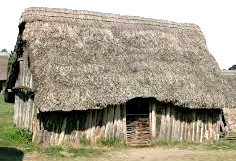
The early cluster of buildings would have been constructed with
simple wood frames, thatched roofs and wattle and daub type panel
walls, all using materials available very locally. Over the
centuries, these would have become a little more substantial, using
cob and stone for more robust walls, and storage lofts in the roof
spaces. This development of building structure would have taken many
centuries.
I think it would have been later, towards 1000AD, that Castle street began to fill with more buildings, both storage and domestic dwellings, to form the beginnings of the village street we might recognise today.
Most, if not all of any pre-1100 buildings would have been lost or redeveloped into the more recognisable mediaeval buildings to form the basis of the early village street. The buildings will have gone through several changes over the earlier years but, with little if any evidence that I am aware of, we don't really know the extent.
These older buildings would usually have started as single storey, and only later, stage by stage, would upper stories have been added. I suspect that any early buildings would have been spread along the lower (eastern) section of the street, as beyond that the ground starts to rise more rapidly. Only later, in the mediaeval era, might buildings have been established in the upper (western) section of Castle street.
It is likely that while the castle was in existence from 1000-1100s through to the 1400s with its bailey settlement areas, and possible early dwellings alongside (what is now known as Castle Hill) not much residential accommodation was likely to have existed in Castle street itself, apart from maybe the occasional laborer's cottage.
There would probably have been agricultural storage buildings and small workshops, possibly spreading away from the junction centre. But when the castle came to the end of its use and was demolished in the 1400s, I think it is likely that was the time that domestic building would have begun to spread through Castle street in earnest. My guess is that most of Castle street would have been in use by the late 1400s or thereabouts.
Local burgage plots would have been established, mainly to the south of Castle street, which acted as areas of land for individual dwellings to provide for themselves during the mediaeval period. These burgage areas remain today as the long gardens behind the buildings in this section.
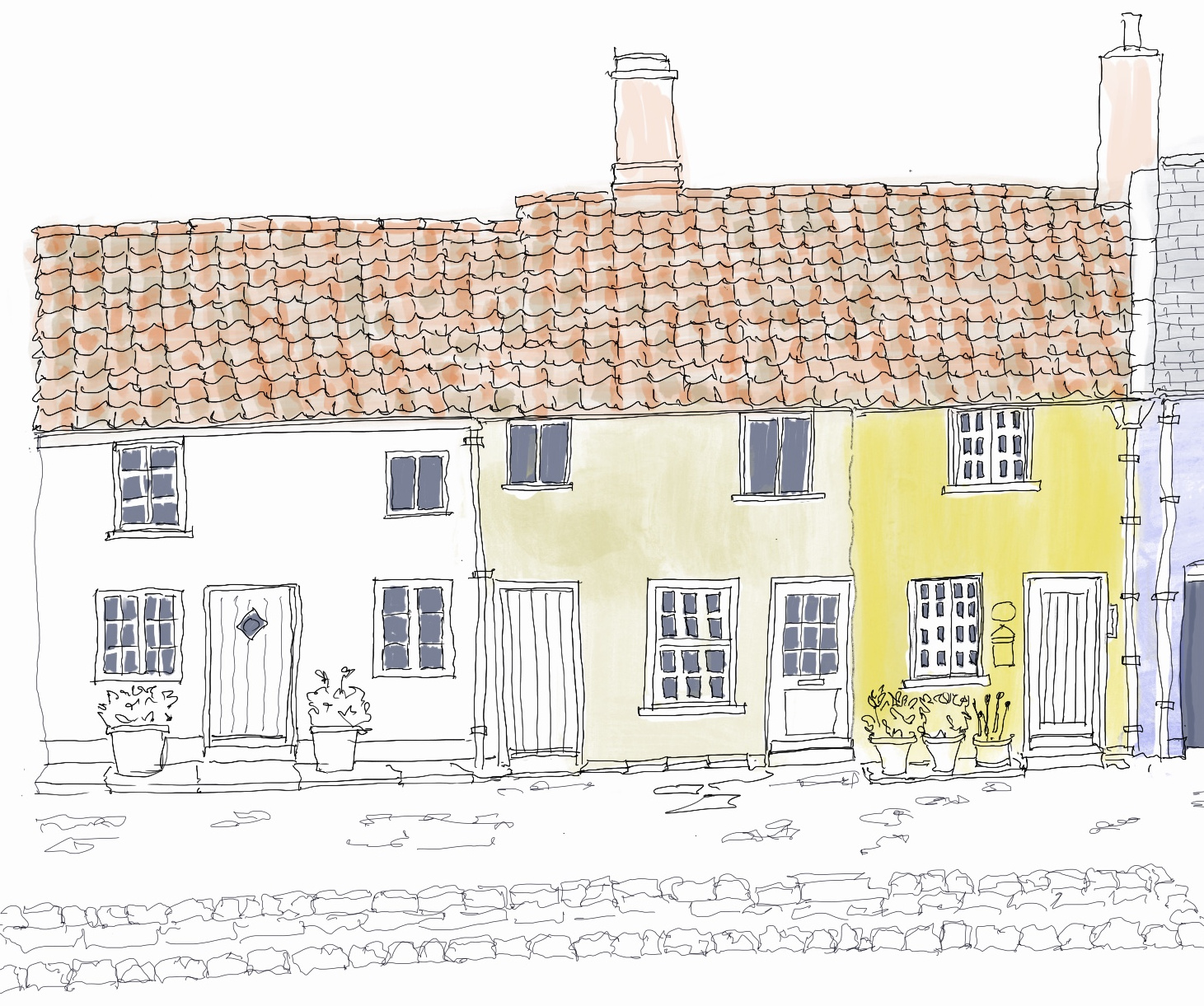
I have read that current day numbers 20-22-24 in Castle street
could have started as what was known as a 'cross passage house'
probably from the early mediaeval period.
This type of house usually started as two or three roomed buildings with a passage passing through from front to rear. What often happened with these was that one end room was used as a service and storage area, with the passage passing next to it, then the central living area with the third as a sleeping area. There was usually a central fire in the hall area, but originally without a chimney, so smoke would have filtered through the roof timbers and thatch. Only later would upper stories be added to the two end rooms, leaving the central 'hall' room open to the roof (so the smoke could still escape). Later a chimney would have been added and then, later, an upper storey inserted in the central hall room.
Possible evolution process from typical cross passage house to cottages:
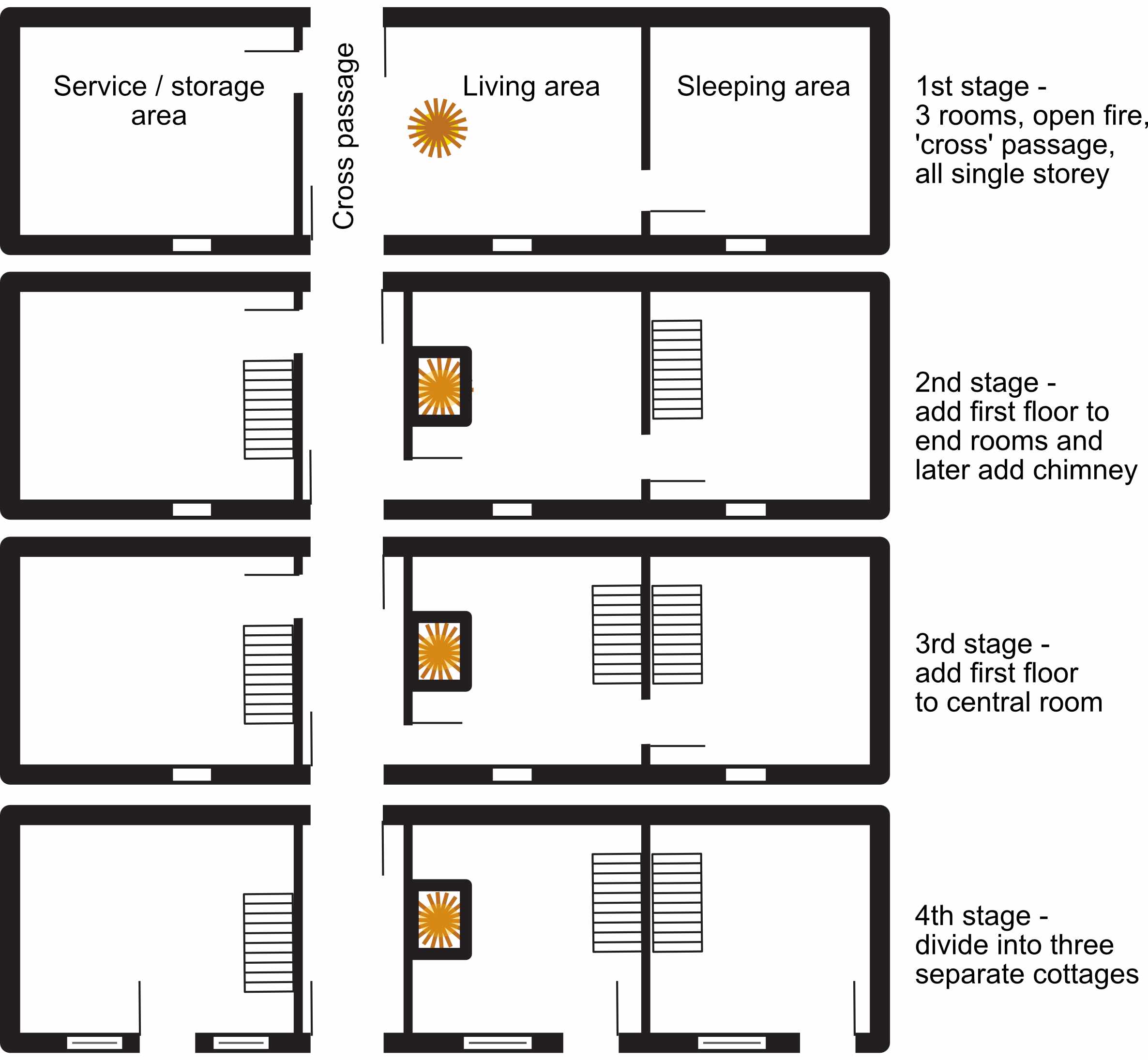
Whether this is how these current cottages in Castle street developed I have no idea! As these cottages are near to the lower end of Castle street, it is possible that they were originally part of the trading service areas, later converted to, or replaced by the early cross passage house.
Remember that during the mediaeval development of this street, the buildings would still have been more simple than today, with small openings and minimal window size before the general availability of glass came in around the 1500s. Before that, any openings may have had internal shutters, or animal skin 'curtains' to keep some of the wind out, so the whole image of the street would have been a far cry from today's abundance of glass.
Early window glass of the 1500s and 1600s would have been small rectangular or diamond shaped panes which were joined together with lead beading and mounted onto an iron frame to form the earliest opening glazed windows here in Stowey.
Up until the late 1600s all buildings would have been vernacular - the original vernacular buildings were truly local, as local builders learned from their predecessors, and local materials prevailed. Buildings were created for purpose rather than exterior appearance, so windows and doors were placed where they needed to be rather than to fit an exterior design.
Later, towards the end of the 1600s, the styles began to change and 'design' became part of the building process with careful layout of fenestration becoming more usual. A wider range of materials became available from further afield, and specific styles became common across the country echoing the styles of that period rather than the location.
The most obvious examples of change from the vernacular in Castle street are the Georgian buildings with their carefully designed proportions and symmetry. This was a style which had been initially designed in the larger towns and cities but which then filtered down to the smaller village streets with the 'gentrification' brought about through business and wealth.
Buildings would have spread up the whole of Castle Street over the two or three hundred years up to around 1700.
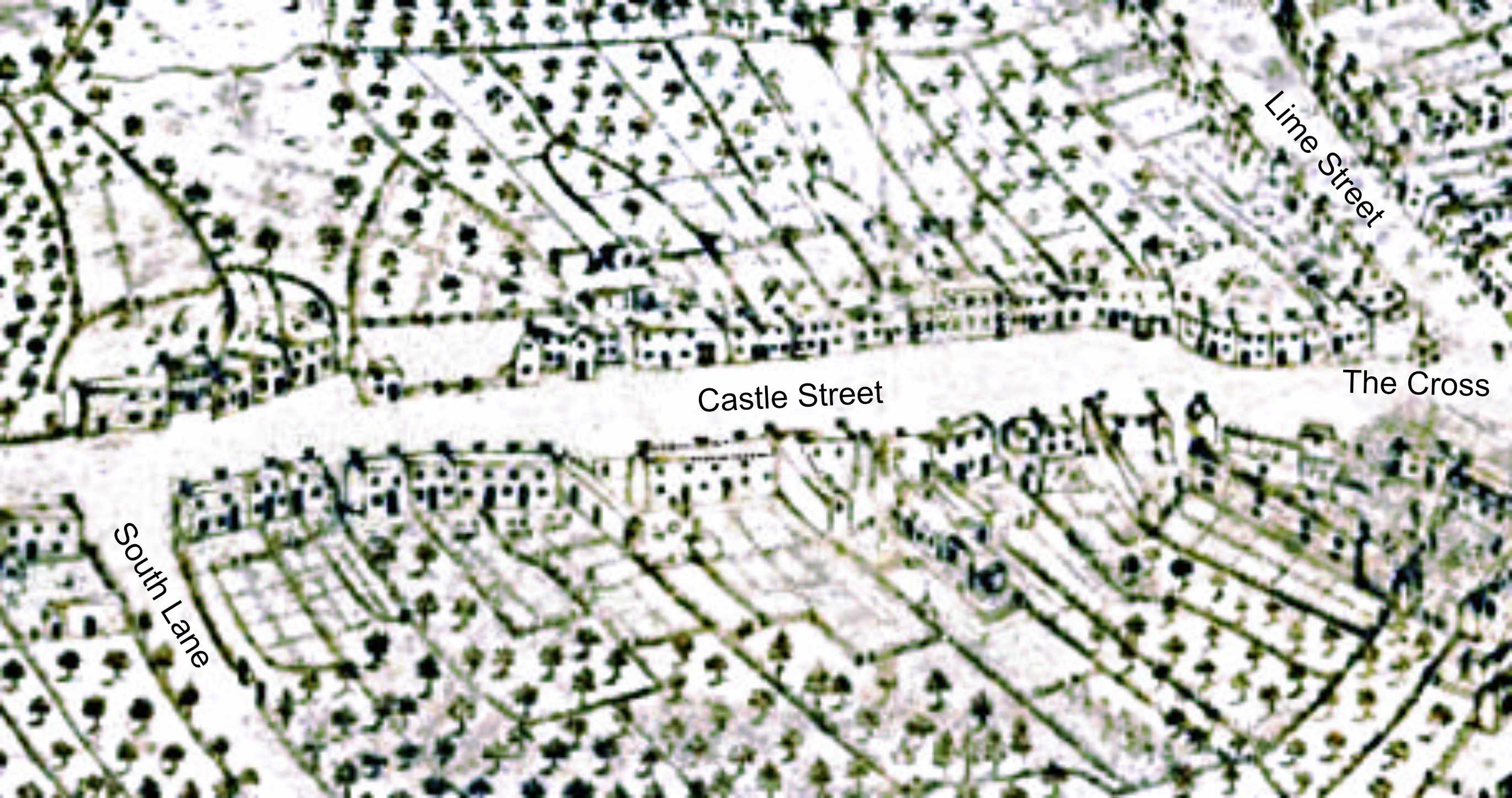
The 1750 map (above) shows a comprehensive building coverage of almost the whole of Castle street. The earlier ones have probably been redeveloped at a later date, either because they were burned down (thatch and open fires were not the safest combination), or the older simple construction simply did not survive.
In some cases parts of the older sections may have survived and been incorporated in the later developed buildings; substantial chimney stacks for instance are the most likely to have survived as they would have been the most robust sections due to their scale; any redevelopment being built around them.
Most buildings here were constructed with local stone, many originally would have had lime rendering for extra protection as can be seen still in the early 1900s photographs - later the rendering was sometimes removed and the stone exposed with careful pointing.
In the 1700s, the Georgian building boom started to affect Stowey, with the obvious examples of current numbers 21 and 28, which are examples of the 'Georgian' style which was not of local origin but could be found almost anywhere in the country. These probably replaced previous vernacular buildings: so the start of the distillation of the Somerset vernacular style had set in for Castle street about 300 years ago!
Larger scale red brick buildings started to take dominant positions in Castle street, thanks in part to the major brick and tile industry which had grown locally in Bridgwater.
More broadly, through the 1700 and 1800s, there were modifications to many buildings. Most obvious and common was the raising of the eaves height. This was usually linked to the change from thatched roofs to tiles. The original thatched roofs needed to be of a steep pitch to aid the quick run-off of water, whereas the tile roofs could be laid at a lower pitch. The tell-tale extra height structure is still visible on several buildings, but there are probably many more which are concealed by rendering.
Pantiles (the large S shaped roof tile) were, and still are common in this area, but I had not realised that they used not to be common elsewhere in the west of England. They were originally imported from Holland from the early 1700s, and then manufactured in the eastern counties of England. It was only the local industry in Bridgwater that manufactured them here in the west through to the late 1800s meaning that for practical reasons, the pantiles were originally only found locally within a day's journey by horse drawn cart from Bridgwater.
I heard recently that the Dutch word for tile is 'pan', so Pantile is literally tiletile!
I have previously put forward my ideas of why the settlement may have developed here, so using those ideas as a starting point, we can imagine that during the dark ages, (ie post-Roman, pre-Norman) for several hundreds of years before the medieval period, some simple buildings would have gradually been established to serve the likely resting location for traders crossing the hills using the old trading routes.
Stowey may have had a collection of simple buildings which served as shelters and fodder storage etc for traders passing through, perhaps growing enough to be classed as a hamlet.
Any really early buildings would probably have been clustered around the junction which is now the cross rather than lined up what later became Castle street; the track and brook that led to the traders route over the hills would have been just that initially, only much later being lined with buildings.
Possibly
any early buildings may have looked similar to this
I think it would have been later, towards 1000AD, that Castle street began to fill with more buildings, both storage and domestic dwellings, to form the beginnings of the village street we might recognise today.
The early beginnings of the
'real' Castle street
Most, if not all of any pre-1100 buildings would have been lost or redeveloped into the more recognisable mediaeval buildings to form the basis of the early village street. The buildings will have gone through several changes over the earlier years but, with little if any evidence that I am aware of, we don't really know the extent.
These older buildings would usually have started as single storey, and only later, stage by stage, would upper stories have been added. I suspect that any early buildings would have been spread along the lower (eastern) section of the street, as beyond that the ground starts to rise more rapidly. Only later, in the mediaeval era, might buildings have been established in the upper (western) section of Castle street.
It is likely that while the castle was in existence from 1000-1100s through to the 1400s with its bailey settlement areas, and possible early dwellings alongside (what is now known as Castle Hill) not much residential accommodation was likely to have existed in Castle street itself, apart from maybe the occasional laborer's cottage.
There would probably have been agricultural storage buildings and small workshops, possibly spreading away from the junction centre. But when the castle came to the end of its use and was demolished in the 1400s, I think it is likely that was the time that domestic building would have begun to spread through Castle street in earnest. My guess is that most of Castle street would have been in use by the late 1400s or thereabouts.
Local burgage plots would have been established, mainly to the south of Castle street, which acted as areas of land for individual dwellings to provide for themselves during the mediaeval period. These burgage areas remain today as the long gardens behind the buildings in this section.
Nos.
20-22-24 sketch
This type of house usually started as two or three roomed buildings with a passage passing through from front to rear. What often happened with these was that one end room was used as a service and storage area, with the passage passing next to it, then the central living area with the third as a sleeping area. There was usually a central fire in the hall area, but originally without a chimney, so smoke would have filtered through the roof timbers and thatch. Only later would upper stories be added to the two end rooms, leaving the central 'hall' room open to the roof (so the smoke could still escape). Later a chimney would have been added and then, later, an upper storey inserted in the central hall room.
Possible evolution process from typical cross passage house to cottages:
Whether this is how these current cottages in Castle street developed I have no idea! As these cottages are near to the lower end of Castle street, it is possible that they were originally part of the trading service areas, later converted to, or replaced by the early cross passage house.
Remember that during the mediaeval development of this street, the buildings would still have been more simple than today, with small openings and minimal window size before the general availability of glass came in around the 1500s. Before that, any openings may have had internal shutters, or animal skin 'curtains' to keep some of the wind out, so the whole image of the street would have been a far cry from today's abundance of glass.
Early window glass of the 1500s and 1600s would have been small rectangular or diamond shaped panes which were joined together with lead beading and mounted onto an iron frame to form the earliest opening glazed windows here in Stowey.
From vernacular to style or
period
Up until the late 1600s all buildings would have been vernacular - the original vernacular buildings were truly local, as local builders learned from their predecessors, and local materials prevailed. Buildings were created for purpose rather than exterior appearance, so windows and doors were placed where they needed to be rather than to fit an exterior design.
Later, towards the end of the 1600s, the styles began to change and 'design' became part of the building process with careful layout of fenestration becoming more usual. A wider range of materials became available from further afield, and specific styles became common across the country echoing the styles of that period rather than the location.
The most obvious examples of change from the vernacular in Castle street are the Georgian buildings with their carefully designed proportions and symmetry. This was a style which had been initially designed in the larger towns and cities but which then filtered down to the smaller village streets with the 'gentrification' brought about through business and wealth.
Buildings would have spread up the whole of Castle Street over the two or three hundred years up to around 1700.
The 1750 map (above) shows a comprehensive building coverage of almost the whole of Castle street. The earlier ones have probably been redeveloped at a later date, either because they were burned down (thatch and open fires were not the safest combination), or the older simple construction simply did not survive.
In some cases parts of the older sections may have survived and been incorporated in the later developed buildings; substantial chimney stacks for instance are the most likely to have survived as they would have been the most robust sections due to their scale; any redevelopment being built around them.
Most buildings here were constructed with local stone, many originally would have had lime rendering for extra protection as can be seen still in the early 1900s photographs - later the rendering was sometimes removed and the stone exposed with careful pointing.
In the 1700s, the Georgian building boom started to affect Stowey, with the obvious examples of current numbers 21 and 28, which are examples of the 'Georgian' style which was not of local origin but could be found almost anywhere in the country. These probably replaced previous vernacular buildings: so the start of the distillation of the Somerset vernacular style had set in for Castle street about 300 years ago!
Larger scale red brick buildings started to take dominant positions in Castle street, thanks in part to the major brick and tile industry which had grown locally in Bridgwater.
More broadly, through the 1700 and 1800s, there were modifications to many buildings. Most obvious and common was the raising of the eaves height. This was usually linked to the change from thatched roofs to tiles. The original thatched roofs needed to be of a steep pitch to aid the quick run-off of water, whereas the tile roofs could be laid at a lower pitch. The tell-tale extra height structure is still visible on several buildings, but there are probably many more which are concealed by rendering.
Pantiles (the large S shaped roof tile) were, and still are common in this area, but I had not realised that they used not to be common elsewhere in the west of England. They were originally imported from Holland from the early 1700s, and then manufactured in the eastern counties of England. It was only the local industry in Bridgwater that manufactured them here in the west through to the late 1800s meaning that for practical reasons, the pantiles were originally only found locally within a day's journey by horse drawn cart from Bridgwater.
I heard recently that the Dutch word for tile is 'pan', so Pantile is literally tiletile!
I
also understand that the double roman tile, which often took over
from the pantile, was actually first designed in Bridgwater. In the
late 1700s and early 1800s, slate started to become more common due
to several factors.
One thing I find interesting is that the whole length of both sides of Castle street appears to have buildings fronting on to the street by the mid 1700s, except, that is, for the area that is now the car park. There was a gap in the buildings at this point from the earliest information I can find and it has continued unbuilt to this day. When the whole of the rest of Castle street had buildings both sides, I wonder why this section remained open?
I do wonder if it had something to do with the course of the brook. I suspect that originally, before there was the channel built to keep the brook in a confined course, it would have originally simply been a meandering open brook. Perhaps the original route crossed through this open area and formed a ford across the track (now Castle Street) before carrying on down towards the junction. This would suggest that the open area which is now the car park may have been where the brook met what is now Castle street, somewhat boggy, and hence prevented any building. When the brook was later confined into the channel, and rerouted and piped under the street, the area left was not immediately filled with more houses, but remained an open area.
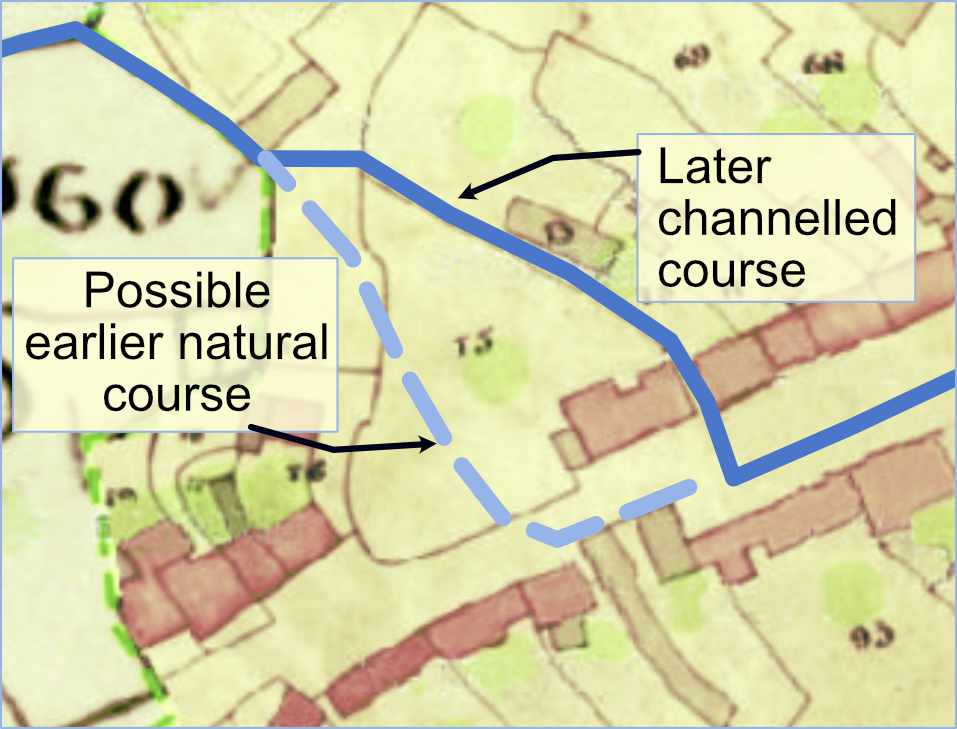
1840 tithe map extract
In the 1840 tithe map, the building to the east of the space looks to be larger than the one there now; perhaps that was part of the ownership of this whole area, and which prevented any building infill? There were later buildings behind of the school and barkhouse, but still nothing on the road frontage, except much later when the telephone exchange (now the vet's building) was built to one side, roughly where there appeared to be a smaller building on the 1750 map. Clearly, now that the area has the car park with the entrance to that and the library (old school) using that gap in buildings, it is unlikely to change in the foreseeable future.
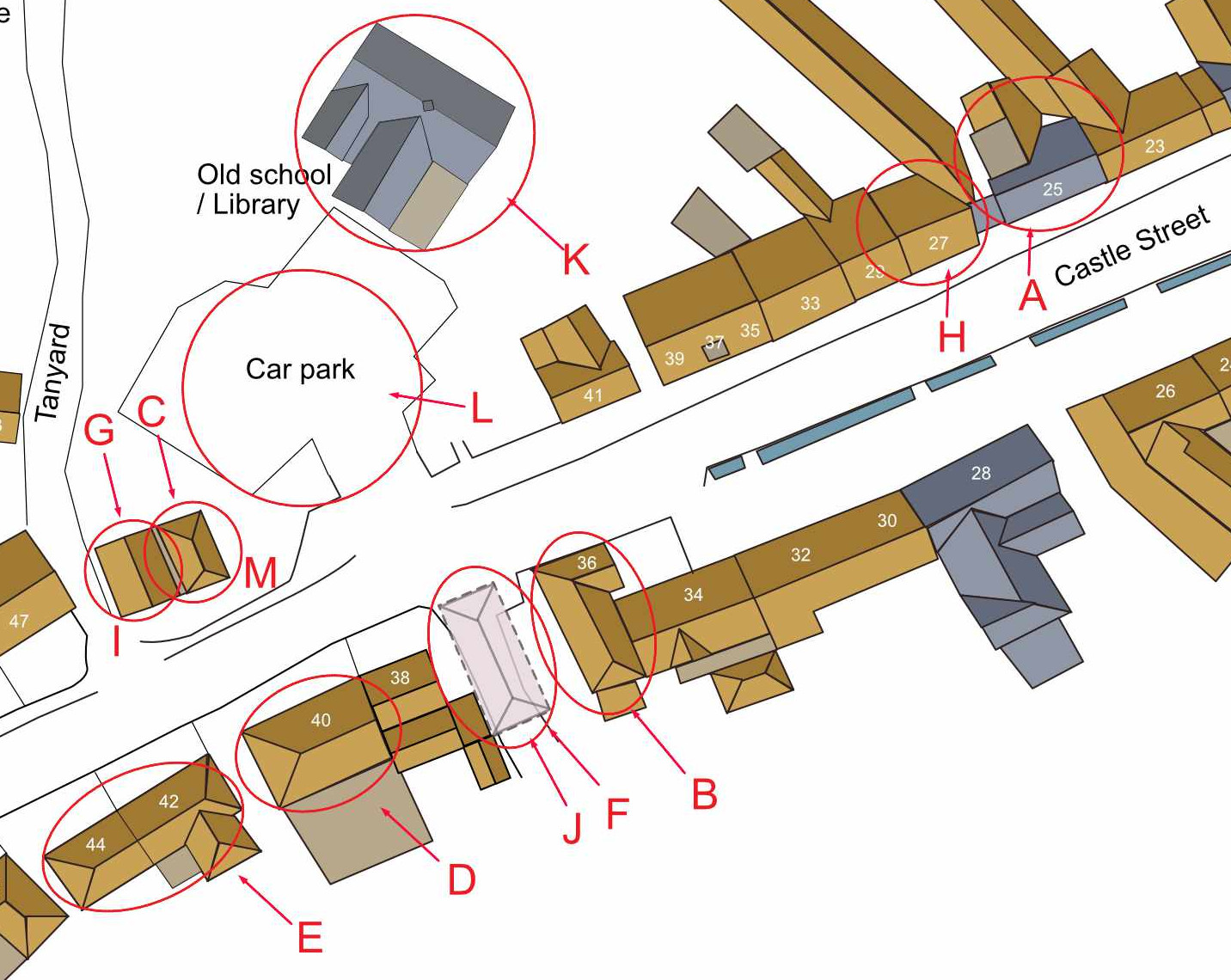
After 1900 things really started to change as far as losing the early local style buildings goes. During the 1900s, particularly the central section of Castle street was almost completely changed in the 'development' of the area. eg:
Pre-WW1
A - 1910 - No 25, The 'Old Cider House' was built on site of demolished old building (previous cider house?)
Post-WW1
B - 1920s - No 36 was built on site of a single story store/workshop building from late 1700s.
Castle street building gap
One thing I find interesting is that the whole length of both sides of Castle street appears to have buildings fronting on to the street by the mid 1700s, except, that is, for the area that is now the car park. There was a gap in the buildings at this point from the earliest information I can find and it has continued unbuilt to this day. When the whole of the rest of Castle street had buildings both sides, I wonder why this section remained open?
I do wonder if it had something to do with the course of the brook. I suspect that originally, before there was the channel built to keep the brook in a confined course, it would have originally simply been a meandering open brook. Perhaps the original route crossed through this open area and formed a ford across the track (now Castle Street) before carrying on down towards the junction. This would suggest that the open area which is now the car park may have been where the brook met what is now Castle street, somewhat boggy, and hence prevented any building. When the brook was later confined into the channel, and rerouted and piped under the street, the area left was not immediately filled with more houses, but remained an open area.
1840 tithe map extract
In the 1840 tithe map, the building to the east of the space looks to be larger than the one there now; perhaps that was part of the ownership of this whole area, and which prevented any building infill? There were later buildings behind of the school and barkhouse, but still nothing on the road frontage, except much later when the telephone exchange (now the vet's building) was built to one side, roughly where there appeared to be a smaller building on the 1750 map. Clearly, now that the area has the car park with the entrance to that and the library (old school) using that gap in buildings, it is unlikely to change in the foreseeable future.
The 1900s bring major changes
After 1900 things really started to change as far as losing the early local style buildings goes. During the 1900s, particularly the central section of Castle street was almost completely changed in the 'development' of the area. eg:
Pre-WW1
A - 1910 - No 25, The 'Old Cider House' was built on site of demolished old building (previous cider house?)
Post-WW1
B - 1920s - No 36 was built on site of a single story store/workshop building from late 1700s.
1926-1930,
showing telegraph poles but no exchange building
C
- 1926-30 - The first section of the telephone exchange was
built (eastern side with hipped roof).
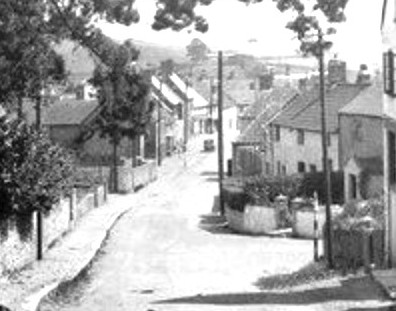
I have read that there was a manual exchange in Stowey from 1926, but in 1930 this became an automatic exchange. Judging by this photograph, which shows the telegraph poles but no exchange building, I think the exchange was probably built in 1930, but I don't know where the manual exchange was for the preceding four years.
I have read that there was a manual exchange in Stowey from 1926, but in 1930 this became an automatic exchange. Judging by this photograph, which shows the telegraph poles but no exchange building, I think the exchange was probably built in 1930, but I don't know where the manual exchange was for the preceding four years.
D - 1936-7 'Venn's Stores', which later became Castle Stores, was built on the site of a pair of vernacular cottages which were demolished to make way for the shop premises.
E - date? No 42-44 was built on the site of demolished vernacular cottages (possibly old poor house?).
Post-WW2
F - 1950s? Fire station, or more accurately, storage for the fire engine, was created by making vehicular entrance to end of the old (pre-1750) agricultural building between no 36 and no 38.
G - 1950s - Second section of telephone exchange built as extension for increased telephone use (western side with gable style roof).
H - 1960s? No 27 appears to have been rebuilt (possibly after a fire) with different fenestration, changing its character.
I - 1978 - The telephone exchange was moved to a new location in Bannison Road, leaving the Castle street premises vacant.
J - 1978-9 Pre-1750 building, later used as fire station, was demolished to provide access to area behind for two new bungalows.
K - 1979-80 The school moved to new location off Mill Lane and the old building became the library.
L - 1979-80 - The creation of the car park and public loo building adjacent to the old school / new library.
M - 1980s - The old telephone exchange was converted and became the vet surgery.
'Modernisation' - water,
telephone and electricity
More generally through the 1900s, Castle street saw the introduction of piped water around 1900; then the telephone service from 1926 followed by electricity sometime around 1930 (I can't find an exact date), both with their abundance of poles and wires seen in photos of the time. Much of this wiring was fortunately later put underground, but still a few telegraph poles remain in the upper (western) section.
The style of buildings in the 1900s also saw a change in proportions to windows, where the original square or vertical emphasis was lost to windows that are often wider than they are tall. This may seem a small change but it does change the general characteristic of the fenestration through the street.
All the original buildings of Castle street would have been truly vernacular. Over time, some would have been demolished and replaced with new, whereas others would have been altered, often initially to provide larger windows with the availability of larger panes of glass. These changes have continued and some more recent alterations are seen from photographs from the early 1900s; so the process of losing the vernacular has been a continuing one from the late 1600s
The spread of 'improvements' with little regard to the vernacular style continues to this day. Plastic windows, often complete with their 'fake' glazing bars (one of my pet hates) seem to be the latest change spreading like wildfire through the street.
I find it sad, but inevitable, that hundreds of years of vernacular local style is disappearing before our eyes. The 'conservation area' status is somewhat meaningless - far too late and far too ineffective to influence what we are losing. But then, the takeover of everywhere by motor vehicles means we are hard put to it to see the buildings at all.
I know that it is naive of me to think 'progress' would not happen, but it does make me sad to see the loss of what must have been a really traditional street as far as the buildings were concerned; but I suppose, realistically, one would have to go back 350 years to see the truly vernacular Castle street. The simple, small unpretentious buildings of yesteryear are not what is wanted in today's world.
The outside view - a sum of all
the parts
When we live in our houses, we look out of the windows at the scene around us, but we don't see the exterior of our own house nearly as much as others do, whether they be neighbours opposite with a constant view, or those just passing by.
The appearance of each individual building forms part of the overall picture of the street.
Design style, scale, materials and colours all affect not just the appearance of the individual building, but also adds to, or detracts from, the overall picture of the street or area.
Do we, therefore, have a responsibility to others and the area generally to ensure our building is a positive rather than negative influence on the overall picture? And who decides what makes the difference? Are there any generally accepted views or is it all subjective?
Today the planning system tries to avoid dramatic eyesores, but this can lead to a rather prescriptive view of what is good or acceptable and what is not. This can then restrict individual inputs which could restrict progress of style. So should there be a community input and discussion, or do we just have to try and be respectful with our own choices, and accept those of others?
Looking at Castle street today, there is quite a mixture of buildings both in scale and in style. A few stand out as different from what used to be the norm, so probably had an impact when first built. The first obvious one being Poole House which, at the time it was built in the 1700s, would have been even more dominant than it is today. Clearly of a style becoming popular in towns and cities it must have been quite a statement here in what was at the time still a vernacular rural village street.
Much more recently, the nearby Old Cider House was also out of the norm for Castle street, being of red brick and slate, and of a fairly 'grand' style of building, which again was more usual for a town setting; very different from what was on the site before. As this was built as recently as 1910, I wonder whether there was an architect involved (who did not have a village background), or perhaps it was a design from one of the pattern books of architect designed houses for no particular location that were available at the time, a design which was chosen by the then owner or builder?
Either way, these two still stand out as 'different' in design from the rest of the street.
The front brick extension of No.36 facing back down the length of Castle street, which was built around 1920, also has the height and contrast, particularly due to the gable above, complete with mock timbering, which puts it apart from the traditional; this too was a far cry from the original single storey workshop/store building on the site previously.
I suppose it is subjective as to whether these different buildings could be seen either as additions to an interesting mix, or slightly out of keeping with the overall heritage picture. Perhaps they can be seen as a bit of both?
All these are just my own personal observations and thoughts and not meant as criticisms; all buildings are of their own time and illustrate the nature of change; my interest is how individual buildings can change the overall picture!
Of course, the whole street is totally different from what it was originally, with many original buildings altered to suit their new inhabitants; due mainly to the fact that the way we live in a village today is totally different from the lives of those who lived here all that time ago. Back then, the village would have been a self sufficient collection of people and their dwellings all working together in a relatively closed community. Whereas now the village as such is simply a collection of independent individuals who just happen to live in the same street and village. Also, increasingly, some buildings are now not permanently 'inhabited' but 'let out' to occasional visiting people, or simply left vacant between the owner's occasional visits, none of which contributes to the form of community as it would have been in the past.
I wonder what Castle Street will be like in a couple of hundred years time from now.
I next want to look at the individual buildings in Castle street, and see if there are any visible clues as to how they may have evolved from earlier times - if you are still with me, here are a few individual building notes...
....
(This page is still under construction, please come back to see future additions.)
....