

The materials and elements used in the buildings
In danger of stating the obvious, all buildings are dependent on the materials used in their construction.
Over the years, the materials available for the buildings in Castle Street will have changed, and hence the appearance of the buildings will reflect those changes.
The following notes look at the various parts of the buildings and explore how they may have changed over time with the changing availability and cost of different materials.
The original idea for this page was to briefly look at the various building materials that have been used in Castle street. However, as I worked through different parts of the site, I found myself wondering more about some of the details that I was not sure about, so started reading around and making a few notes.
Well, it got rather out of hand, and I found my pondering about how and why the various elements had developed and evolved over the years, and the notes became more than I ever intended.
The consequence of this is that this page is probably only of interest to me as a record of what I learned during my searching around various subjects. The notes range from the obvious to some more nerdy details, so feel free to skip the whole or parts of this page!
Just a word of warning here: in case at any point I sound as if I know what I am talking about, please don't be fooled... most will be what I have found out whilst trying to answer my own questions, so any 'wisdom and knowledge' will be that of others! I don't want anyone to get the wrong idea, I am no expert, just a curious and interested amateur.
For anyone still with me, these are the subjects I have looked at:
Basic construction: roofs, walls, chimneys, windows and doors - sounds simple doesn't it? Its surprising where an inquisitive mind takes one...

Castle Street, north side, eastern section
Windows
Possibly the element that has changed most over the development of buildings.
The early style and size of windows was basically determined by the limitations of the availability of glass, and the development of its manufacturing methods.
Originally windows would have been small timber frames without glass, subdivided to make the gaps small enough to prevent intruders! In fact many were intended as much for ventilation for the internal fire as they were for letting light in, which was more readily achieved by opening the door. For obvious reasons, these open windows were mostly installed in the side of the building away from the prevailing wind, and simple timber internal shutters or animal skin curtains would have given a little draft control.
Early glass known as 'broad' glass (similar to later 'cylinder' glass, see below) was expensive and available from around 1200-ish - earlier imported glass was available but extremely expensive.
It is unlikely that any glass in windows appeared in Stowey before the 1400s.
In Stowey, the first glass used would have been 'Crown' glass - these were blown glass which was spun using centrifugal force to create a disc which varied in thickness from the centre outwards. This gave the characteristic radial ripple effect; this became common and was produced from the mid 1400s until mid 1800s but only allowed small panes. This Crown method glass disc was cut into small rectangular or diamond shapes for best efficiency of the shape; there would have been various cutting combinations for the discs. One example is shown below:

These left the characteristic bullseye centre panel sections, which were used as cheap options for locations which did not require any clarity of view, but many were sent to scrap and, presumably, recycled back into the melting pot for future discs.
The small diamond or rectangular panes produced by this method were fixed together with lead strips known as 'cames' (like stained glass today) the multi-pane panel was then fixed to an iron frame with lead rivets. The whole window frame was then hung with simple peg and eye type hinges onto simple wood or iron frames. These windows would have been the most likely to be in the buildings of Castle street between the 1400s and 1800s.
One quite elaborate example is seen in the early photos of the old school:

There are still a few windows of the early style existing in Castle street today, although presumably now with modern glass without the ripple effect.
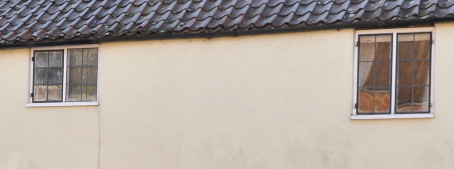
These are at no22
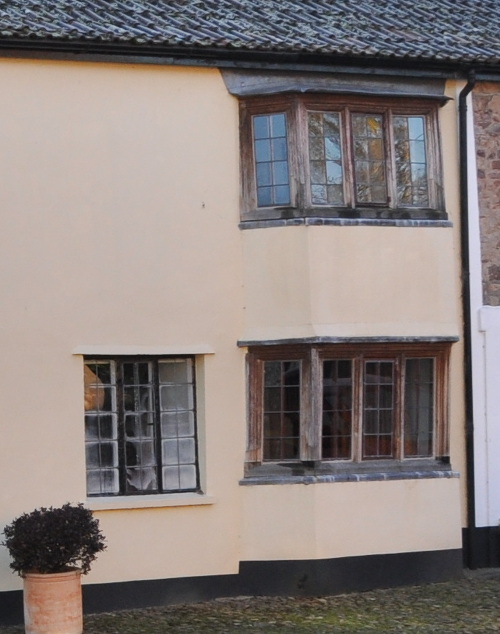
and at no32
During the 1800s, glass sizes gradually increased.
'Cylinder' glass enabled increasingly larger panes through the 1800s - as the name suggests, it is made by blowing a long glass cylinder, then, while still warm and flexible, cutting off the ends and splitting lengthways to open out to form a larger flat sheet.
Plate glass enabled even larger sheet sizes but was only available from the late 1800s'. One early example in Castle street was the shop front in no21; the photo of about 1900 clearly shows a large glass window in place at that time:

I don't know exactly when the shop front was installed, but that size of glass would have only been available since the late 1800s.
Glazing bars - (real, applied or false - now plastic!)
As mentioned above, the first windows with glass used the small diamond or rectangular panes which were held together in lead strips, usually within an iron outer frame. These gave way to wood glazing bars in wood frames when slightly larger glass panes became available at a reasonable cost. The purpose of these glazing bars was to join small panes of glass together within a larger frame in order to produce a casement of a reasonable size. The individual small panes gave a characteristic varied reflective appearance as they were rarely in exactly the same plane so each section gave a slightly different reflection.
The later use of larger sheets of glass, that were then given false 'applied' glazing bars over the glass, which were entirely for visual effect, produced an overall window which gave away its false appearance due to the completely even reflection across the whole window produced by the single glass pane beneath the false glazing bars.
Today we have gone one step further and frequently the false glazing bars are actually enclosed within the two panes of a double glazed unit. The purpose is presumably to maintain the 'traditional', small pane appearance. The question is when is the faking of the traditional appearance justified, and when is it just fake? Everyone will have their own opinion on that, ranging from the devout purists, to the "so what"? or "simply don't care"! My own opinion would depend on the individual building, but would centre on the use of 'real' glazing bars (ie with separate glazed units) if required for aesthetics, or if the window was not too large, then the honesty of omitting the glazing bars would be preferable in my view (as I did on my own house - I am not a fan of decoration for its own sake - a humble cottage, so keep it simple!).
Sash windows
Of course, more broadly, the size of windows would have gradually increased over time. The early buildings often having very small windows which would not have allowed much light into the building, so it is only natural that the overall size of windows grew. The earlier ones were simple, small side hung casements, but during the 1700s, the use of sash (vertically sliding) windows became very popular as they enabled an increase in height to allow more light through.
There is one point of interest (to me, at least) when looking at sash windows: the early ones were simply fitted flush with, or near the face of the building within the structural opening. Due to the construction of the sash units which have side boxes to house the weights required to assist in lifting the units, this gave a heavy visual effect. It was in London in the early 1700s that fire regulations insisted that the later sash window boxes were set in behind the masonry face, which helped protect the timber from spreading fire. It was soon recognised that this also produced a much more slender appearance as the width of the boxes were hidden from the street view. Although initially required (only in London) by regulation, this soon became the norm by choice across the country.
If you look in Castle street, you will see that No.21 (Poole House) has the older style exposed weight boxes, whereas No.28, on the other side of the street, has the more refined rebated version.
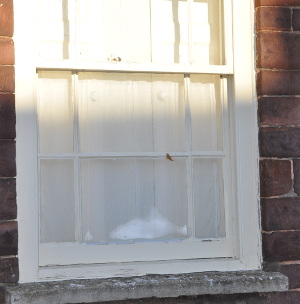

Sorry if this is all too 'nerdy' for you, but I include it for anyone who might be interested!
Bay windows...
Some bay windows are built as part of the original design of the building, whereas others are later additions, usually extended out from an existing standard window. These later additions are often oriel windows, meaning that they do not extend down to floor or ground level but are cantilevered from the wall.
I believe that the earliest versions were installed when previous unglazed windows had glass added when it became more readily available, these were sometimes extended into a bay in order to introduce as much light as possible, as well as increasing the feeling of space in the room.
Other bay or oriel windows were added as a form of small display window for business premises.
Bay windows became very popular in buildings built during the 1700s and 1800s, when they were a means of adding extra space in rooms without extending the whole wall of the house forward.
In Castle street, there are a few examples of different forms:
the distinctive characterful two story bays in no.32 (below left), which is reportedly one of the earliest remaining buildings in the street - I wonder if these are an example of those added when glass became more accessible?


The more classic examples on No.28 (above right) are typical Georgian style built to impress,

whereas those on No.25 (Old Cider House, above) are a bit different, in that they do not protrude onto the street, but the remaining front wall is recessed back away from the street in order to create space for the bays.
Below are those of No.27 (left photo-1928) and No.17 (right photo-1909),
both may have been examples of early display windows for business purposes.


This photo (above) of 1916 shows bay windows of nos: 27, 25 and 17


There are a couple of small bay windows in Nos.14 & 16 which hang over the passing brook and were added sometime during the 1900s.(above)

The example (above) in No.26, looking back down Castle street, is a typical example of the later version, effectively extending the floor area of that section of the building.
Taxes
Historically, taxes affected the number and size of windows for over 100 years:
'window tax' (1696 - 1851) - houses with above a certain number of windows were taxed;
'glass tax' (1746 - 1845) - glass manufactured was taxed by weight.
In
the second half of the 1800s, after the restrictive taxes had ended,
the use of glass became far more abundant.
Doors.
details to follow...still working on this page!
Chimneys.
Chimneys were a relatively late arrival, especially in rural locations like Stowey. Originally the internal fire, used mainly for cooking, would burn wood, and it was bearable for the smoke to be allowed to drift up and escape through the thatch.
Only when coal was started to be burnt in the 1300s and 1400s, along with its unpleasant smell, did the need for a flue become important.
The earliest flues were not structural, but were made of wattle a daub and just took the smoke up to the ridge level. There was the obvious fire risk that this construction produced, so more substantially constructed fireplaces with solid built flues became more common.
Only later, in the 1700s, did what we now recognise as the tall chimney stack above roof level become a common sight in places like Stowey. The main chimneys were usually built of stone, but the latter addition of 'stacks' above the roof only came later with the availability of bricks. Here in Stowey this was partly thanks to the local Bridgwater brick works, as the small regular brick size enabled the accurate construction required for the tall chimney stacks. These often became taller in order to increase the updraft effect and thus reduce smoke backing into the room. The addition of chimney pots added more to the height and the reduced pot diameter helped speed the flow of smoke to draw fumes away from the interior. Some pots became quite decorative and elaborate.
Look at Castle street today and you see numerous chimneys. However, many new buildings of today have no chimneys (eg Bannison road area). Even those that do add chimneys, they are usually there to vent boilers, modern cooking ranges or wood-burning stoves etc with metal flue liners, rather than traditional open fireplaces (eg off Stogursey lane).
Roofs.
Thatch, clay tiles of various forms and slate.
Thatch was the early form of roofing from when the Romans left, all the way through to the early medieval period, and it persisted in some buildings in Castle street through to the early 1900s. It was easy to produce due to the use of local naturally available materials, which provided for the required regular replacement - straw thatch used locally was not so long lasting as reed thatch used elsewhere in the country.
A thatched roof normally needs to have a fairly steep angle of pitch to encourage efficient run off of water. This is why properties with thatched roofs tend to have a lower eaves height, generally below internal ceiling heights, so that ridge heights do not need to be excessive. This leads to the common form of 'eyebrow' (semi dormer) upper floor windows to enable the lower eaves height to combine with reasonable internal window heights.
This often leads to obvious alterations when, at a later date, the thatch is replaced with tile or slate roofing material - the whole roof structure need to change and the tell-tale build up of the upper walls and gable slopes, to provide higher eaves height is sometimes still visible. However, this is often obscured by later rendering of the walls.
Although tiled roofs became common elsewhere in England during the 1300s, thatch remained the most common roofing material in the west country until much later.
The last surviving thatched roof in Castle street was at No 11, which was still under thatch in 1916, as shown in this photo:

Pantiles - the large 'S' shaped tiles became common in this area, although not generally across the west of England. They were originally imported from Holland from the early 1700s, and then manufactured in the eastern counties of England. It was the local brick and tile industry in Bridgwater that manufactured them here through to the late 1800s. This meant that the local pantiles were originally only found within a day's journey by horse drawn cart from Bridgwater. I have read that the double roman tile which often took over from the pantile was actually first designed in Bridgwater.
Compared with the smaller plain tiles used more commonly in eastern England, the larger pantile had less overlap and was therefore a lighter roof, able to be laid at a lower pitch angle. One down side of this was that the looser fit gave greater ventilation through into the roof space, and in winter, wind could drive rain and snow up under the tiles - it was not unknown for the loft to fill up with snow in a blizzard! The more recent use of roof felting below the tiles helped solve that issue.
Slate - in the late 1700s and early 1800s. slate started to become more common due to several factors, not least a tax on fired building products like tiles that was introduced from 1784 to 1850. In time, as transportation improved, slates from Wales were shipped all around the country, including across the Bristol channel to Watchet harbour.
'Nerdy bit alert!' - Feel free to skip the next bit!
Visual differences:
More common elsewhere in the country, the small plain tiles were laid in courses with staggered vertical joints to prevent moisture penetration, so gave a horizontal emphasis. Visually, however, pantiles and roman tiles (single and double), although they were still laid in horizontal courses, due to the constructed interlocking design shape, they were laid without the staggered joints and, together with the vertical ribbing in tile shape, therefore have a more pronounced vertical emphasis. Slates, like plain tiles, are laid with staggered joints, so have a visually horizontal emphasis, although being thinner the emphasis is not so marked.
Here are a few example of different roof materials in Castle street:

Small plain tile roof

Larger pantile roof

Double roman roof

different variation roman roof

Slate roof

Unusual roman style tiled roof with staggered vertical joints
Taxes - Fired building product taxes
fired building products like bricks and tiles were taxed (1784 - 1850) This, together with improving transport facilities, hastened the popularity of slate roofs during the 1800s
Walls.
Walls: cob, stone, brick - and later, blocks - the addition of external render will often obscure clues of previous alterations.
Cob: The gable wall and chimney of our house (38) is constructed of cob on an approx 4-5ft high stone base.
As cob is generally (not always) an older building material, we wonder if our gable wall was originally part of an earlier building.
I suspect there are other buildings in Castle Street with some remaining cob walls.
Cob is mainly a mixture of locally sourced clay and straw, tramped down a little at a time in layers and then left to dry. This was a very slow process and a house might take two years to construct, but it was essentially a low skill process so people would often build their own houses with cob without the need for 'builders', although a stone base was required as a damp course to keep too much moisture from penetrating the cob. As long as the cob was kept relatively dry, it was a long lasting construction method, but if the roof failed or some other damage enabled wet into the cob, it could quickly disintegrate. However, the lost cob could easily be reconfigured and the cob wall rebuilt with the recycled material. Interestingly, the openings were often not built in, but lintels were included in the construction, and the openings cut out beneath once all was dry.
Cob was probably very common in Stowey before medieval times. I suspect there is quite a lot of cob still here in earlier parts of several buildings, as it is in our house, although many of the main walls have been replaced with stone or brick at a later date.
Stone
As buildings developed, more and more stone was used as a much more robust material. Initially, there was an abundance of local stone just lying on the surface for collection; but once that was used up, numerous small local quarries were established around the Quantocks. The largest and longest lasting was Triscombe quarry with the local red sandstone (Hangman grit) which is used extensively through the area.
There are a variety of sandstones used around Stowey, which vary in colour from reds, browns to pale buffs and grey.

Some were hard stone, whereas others were softer which allowed for some shaping, especially for quoins (corner stones) for building corners and to form window and door openings. These probably came from different small quarries around the Quantocks area.

The skill needed to build in stone is greater than with cob - with stone, the craftsman had to select each stone appropriately and lay it individually, but it was essentially a dryer construction so could continue without long drying periods.
Stone came in various sizes and was either laid in courses or random. the coursed stones were often of cut stone giving a more uniform appearance, even if the courses were of different heights.

Many smaller buildings were built with random rubble stone construction, ie, smaller stones put together without courses. These were then usually given a lime render finish with limewash coating for extra protection and sometimes colour. The render was often later removed.

Some stone walls have subsequently been pained, without rendering, which maintains the texture of stonework, but gives an overall even colour across the wall. This painting is sometimes used as a way of disguising and unifying a variety of different stonework beneath.

We also see with stone walls, where openings have been amended, enlarged or moved, it can be difficult to recreate a good neat edge to the window or door opening, so a render border around the opening is applied to give a clean and neat surround.

Brick
During the 1700s and 1800s brick making was a major industry in Bridgwater using clay from the river Parrett estuary area so more and more brick was used in Stowey.
The choice of using stone or brick was dependent on supply and cost, which varied from area to area. The skill required for stone construction was greater than with the uniform sized brick construction. Economies of scale with automation in brick making, and the end of the 'brick tax' in 1850, changed the economics towards bricks and away from stone as the main general building material in the second half of the 1800s.


Bricks were also often used for quoins of stone walls, either for the corners of buildings or around openings.

Render
The main reason for rendering a building is to give the walls a uniform appearance with added weather protection. Sometimes used to cover up a mixture of construction techniques. The smooth, uniform finish can then be coloured with a range of paint colours.
Originally used to cover small random stone walls where there was not the larger stone require for exposed stone finish; although latterly, many random rubble stone walls have had the render removed and careful pointing used instead.
Render was also sometimes used to cover brick walls when a different finish was preferred.

The original render was lime render, but this was overtaken by cement render during the 1900s.
Lime render was in common use before the 1900s, and is still used today, mainly for conservation work. It has a long history.
Limestone was heated in lime kilns to produce quicklime. This was then crushed and mixed with water to produce hydrated lime, which is used to mix lime mortars, renders and limewash. Limewash was painted over lime renders for extra protection and sometimes added colour, but it was not long-lasting so needed to be a regular maintenance job. Lime mortar has been in use for thousands of years and was the main construction mortar used for a very long time.
I wonder if Lime street in Stowey led to lime kilns? (Castle street led to the castle, and St Mary's street led to St Mary's church.)
....
This page is still under review, please come back to see future additions.
....