

No 35-39
I am not sure what to make of this building; it is a large building divided into three smaller homes. The overall size has higher eaves than most of the rest of the street. The eaves are well above the first floor windows, which suggests the original overall scale may not have been for small domestic dwellings. Was it built like this, or has it been changed from a single large building and subdivided into the three dwellings?
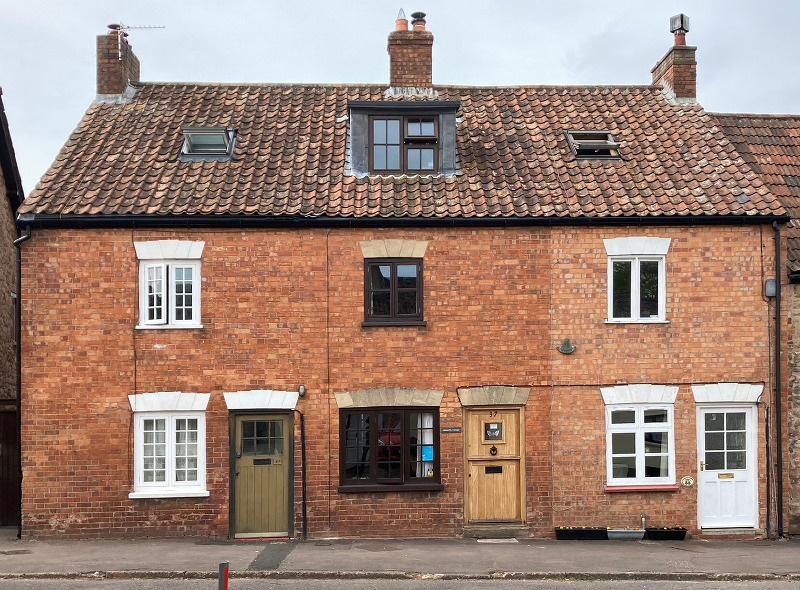
No.35-39

For clues, I looked back at the earlier maps. The 1750 illustrative map shows this building but with a single central doorway with symmetrical windows, as if it was a single important house; but I don't know how much reliance we can have on the accuracy to that sort of detail.

1750 map
Looking at the details of the building, the front wall is of brick, whereas the end gable is stone. It could be that the brick front was a later replacement of what was before. This often happened for instance when an earlier cob built building became decayed and the front wall was unsafe.
 quoin
jointing
quoin
jointingLooking at he gable wall, there are smaller hand made bricks incorporated where the flu is guided up to the central chimney, whereas the front wall is of a later machine made brick, presumably from the Bridgwater works.
There is a chimney at each end of the building and a central one with a different shape. Was this central one original or added later? I really don't know!

1947 photo
More recently, the 1947 photo shows the common style of windows and doors for all three dwellings, with just the left hand ground floor window with fewer panes; whereas now all three dwellings have completely different styles of doors and windows. Also, the brickwork on no.35 has been cleaned at some point, marking another difference from the other two.
Purists would have preferred all three to retain a common style, but I think the difference does show that individuality can mark the differences within the common overall style, although, personally, I do like the common appearance of the 1947 image, and I'm not so sure about the cleaned brickwork which has lost the richer tone of the others, perhaps it will tone down again in another fifty years or so; at least the windows are still all wood casements!
The 1947 photo shows a smaller dormer for no.37, and a smaller roof light on no.39, so these and the new roof light to no.35 were added later.
I still wonder what this was back in the early 1700s or before. Or perhaps I am reading too much into this, and the whole was built as three terraced houses at a later date than I suppose, replacing rather than amending an earlier building - I really don't know.
....
....