

No
21 - Poole House
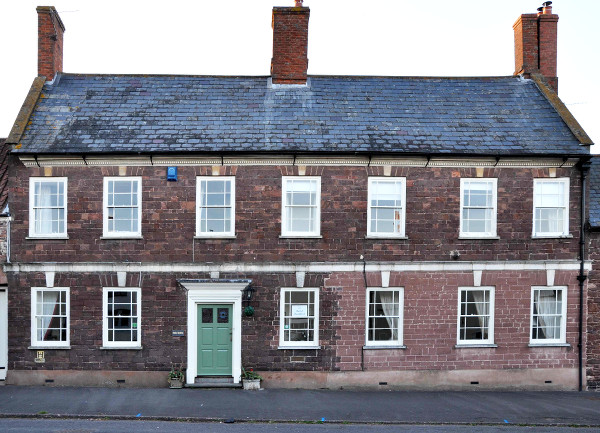

No 21, also known as Poole House, is not your standard village house! It clearly has all the style of a Georgian town house. (Georgian period 1714 - 1830 / 37)
I have always been a little baffled by the building, the Georgian designs were well known for their accurate proportions and symmetry, but no 21 is a little different.

There are seven windows across the first floor level with
corresponding windows at ground level, except, of course, for the
front door. To keep the symmetry, I would have expected the door to
be in the centre, but in no 21 it is one bay to the left. I did
wonder whether the door may have been moved when the right half of
the ground floor was made into shop premises, but now I don't think
so.
At first glance, the seven windows appear to be evenly set out across the width of the building, but when I look a little closer, I notice that the first and last pairs of windows are closer together with the three central windows spaced a little further apart. As the doorway with its surround would need extra space, it would follow that there needed to be that difference in spacing, but one would have expected just the window above the door to be more widely spaced, not the three central ones.
However, once I had read that the building was originally two buildings together, everything suddenly fell into place. There would have been a second doorway, presumably in the fifth bay, making the two houses a mirror pair, externally at least, and all symmetry of the fenestration would be perfect.
Extra note:
After thinking I had this got this worked out, I came across another, rather blurred, photo, this time from before the shop was created - possibly during the 1880s - and it doesn't have the other front door!

My own thought is that the original two houses were probably soon converted into one (I imagine Thomas Poole would have had the whole house as one), so the newly found photo probably shows it as it was at that stage.
Looking more closely, I notice that the window where the second doorway would have been is positioned slightly to the left - you will see that it is not central to the window above, whereas all the others are. My guess is that when they made it into one house, they positioned the new window to suit the interior layout more than keeping the symmetry of the exterior.
Anyway, that fills in an extra stage of the evolution of the building!
Another point to notice is that in the 1880 photo, although it is rather blurred, you can see that the window frames are a light colour, whereas the opening sashes are dark. This contrasts with the current painting where both frame and sashes are white. I feel that the 1880 painting gives the windows a less heavy appearance than the current version - something I intend to cover elsewhere in this website about decorating exteriors including painting windows.
Just one more thing - a baffling set of observations...
I always look for clues of any previous alterations and I am a little baffled by what I see around the left hand ground floor window...
The lintel stones are not like the other windows, instead of the flat stone arch that all the other windows have, this one has two courses of straight stones. Although there has been an attempt at replicating what would have been the joints by surface carving false joints presumably to try and replicate the other window lintels, this is clearly different in construction.
Also, on the same window, there is the tell-tale sign of straight vertical joints below the window, which usually indicates that there was previously a doorway there before the window.
The right hand side is directly fellow the window side, but the left side would suggest a wider space.
This together with the lintel difference makes me wonder just what has been changed, and what was there before.
I don't think there would be a link with the fact that the water hydrant location panel is under this window, that is more likely to be just coincidental.

If anyone reading this has any suggestions about an explanation, I would be interested to hear - Okay I know, no-one else is likely to find this of interest, it's probably just my strangely inquisitive mind!
back to the story...
No 21, also known as Poole House, is not your standard village house! It clearly has all the style of a Georgian town house. (Georgian period 1714 - 1830 / 37)
I have always been a little baffled by the building, the Georgian designs were well known for their accurate proportions and symmetry, but no 21 is a little different.
At first glance, the seven windows appear to be evenly set out across the width of the building, but when I look a little closer, I notice that the first and last pairs of windows are closer together with the three central windows spaced a little further apart. As the doorway with its surround would need extra space, it would follow that there needed to be that difference in spacing, but one would have expected just the window above the door to be more widely spaced, not the three central ones.
However, once I had read that the building was originally two buildings together, everything suddenly fell into place. There would have been a second doorway, presumably in the fifth bay, making the two houses a mirror pair, externally at least, and all symmetry of the fenestration would be perfect.
Extra note:
After thinking I had this got this worked out, I came across another, rather blurred, photo, this time from before the shop was created - possibly during the 1880s - and it doesn't have the other front door!
My own thought is that the original two houses were probably soon converted into one (I imagine Thomas Poole would have had the whole house as one), so the newly found photo probably shows it as it was at that stage.
Looking more closely, I notice that the window where the second doorway would have been is positioned slightly to the left - you will see that it is not central to the window above, whereas all the others are. My guess is that when they made it into one house, they positioned the new window to suit the interior layout more than keeping the symmetry of the exterior.
Anyway, that fills in an extra stage of the evolution of the building!
Another point to notice is that in the 1880 photo, although it is rather blurred, you can see that the window frames are a light colour, whereas the opening sashes are dark. This contrasts with the current painting where both frame and sashes are white. I feel that the 1880 painting gives the windows a less heavy appearance than the current version - something I intend to cover elsewhere in this website about decorating exteriors including painting windows.
Just one more thing - a baffling set of observations...
I always look for clues of any previous alterations and I am a little baffled by what I see around the left hand ground floor window...
The lintel stones are not like the other windows, instead of the flat stone arch that all the other windows have, this one has two courses of straight stones. Although there has been an attempt at replicating what would have been the joints by surface carving false joints presumably to try and replicate the other window lintels, this is clearly different in construction.
Also, on the same window, there is the tell-tale sign of straight vertical joints below the window, which usually indicates that there was previously a doorway there before the window.
The right hand side is directly fellow the window side, but the left side would suggest a wider space.
This together with the lintel difference makes me wonder just what has been changed, and what was there before.
I don't think there would be a link with the fact that the water hydrant location panel is under this window, that is more likely to be just coincidental.
If anyone reading this has any suggestions about an explanation, I would be interested to hear - Okay I know, no-one else is likely to find this of interest, it's probably just my strangely inquisitive mind!
back to the story...
We know that the right half of the building was a shop for at least
a hundred years. The earliest photo I have seen is from around 1895,
when it was already a shop, and I believe it was only around 1989-90
that the shop front was removed and the building became a single
house (again?)
Seeing the shop windows with large sheets of glass was a surprise considering it was pre-1895, but it would seem that the development of glass making had enabled these larger panes to be produced from the late 1800s. A later photo (c.1946) shows one window divided into four - perhaps the large pane was broken and the cost of a replacement was too much as one large sheet?

pre-1910
The building is known as Poole House because it was the home of the well-known Thomas Poole who ran the tannery which was just behind no 21. Thomas took over the tannery business from his father, but I don't know if his father lived in this building before Thomas.
It would seem that Poole owned much of the land behind Castle Street as it was there that the Tannery, the barkhouse and later, the school were built.
The tannery and barkhouse were part of the village's industry that brought some wealth to the village. Thomas built the school, just close to the tannery, as one of the earliest free schools in the country.
One can see from the 1840 map of the area that the tannery was just behind no 21 and the barkhouse a little to the west. The use of the brook was an important part of the business, as it powered the mill to grind the bark and provided the water to soak the bark in tanks to produce the tannin. From what I read, the tanning process is a somewhat pungent process, so the atmosphere around Castle Street was probably somewhat different then!

map c 1850-1860
The map dated somewhere between 1850-88 shows the use of the brook to provide the water source, with a mill pond behind the barkhouse and mill, and the outflow then passing in front of the original school building, before being piped underground to emerge at the south side of Castle street as we see today. The tithe map dated 1840 shows the school building before the extensions on the front, so the brook looks as if it was open passing across in front of the building, only later being piped, presumably when the later extensions were constructed.
Seeing the shop windows with large sheets of glass was a surprise considering it was pre-1895, but it would seem that the development of glass making had enabled these larger panes to be produced from the late 1800s. A later photo (c.1946) shows one window divided into four - perhaps the large pane was broken and the cost of a replacement was too much as one large sheet?
pre-1910
The building is known as Poole House because it was the home of the well-known Thomas Poole who ran the tannery which was just behind no 21. Thomas took over the tannery business from his father, but I don't know if his father lived in this building before Thomas.
It would seem that Poole owned much of the land behind Castle Street as it was there that the Tannery, the barkhouse and later, the school were built.
The tannery and barkhouse were part of the village's industry that brought some wealth to the village. Thomas built the school, just close to the tannery, as one of the earliest free schools in the country.
One can see from the 1840 map of the area that the tannery was just behind no 21 and the barkhouse a little to the west. The use of the brook was an important part of the business, as it powered the mill to grind the bark and provided the water to soak the bark in tanks to produce the tannin. From what I read, the tanning process is a somewhat pungent process, so the atmosphere around Castle Street was probably somewhat different then!
map c 1850-1860
The map dated somewhere between 1850-88 shows the use of the brook to provide the water source, with a mill pond behind the barkhouse and mill, and the outflow then passing in front of the original school building, before being piped underground to emerge at the south side of Castle street as we see today. The tithe map dated 1840 shows the school building before the extensions on the front, so the brook looks as if it was open passing across in front of the building, only later being piped, presumably when the later extensions were constructed.
....
This page is still under review, please come back to see possible future additions.
....