

No
19 - Medway
Coming up Castle street from the cross, on the north side of the road, the cottages were mainly of original vernacular style, but when we get to no19, this building was definitely of a different style and class.
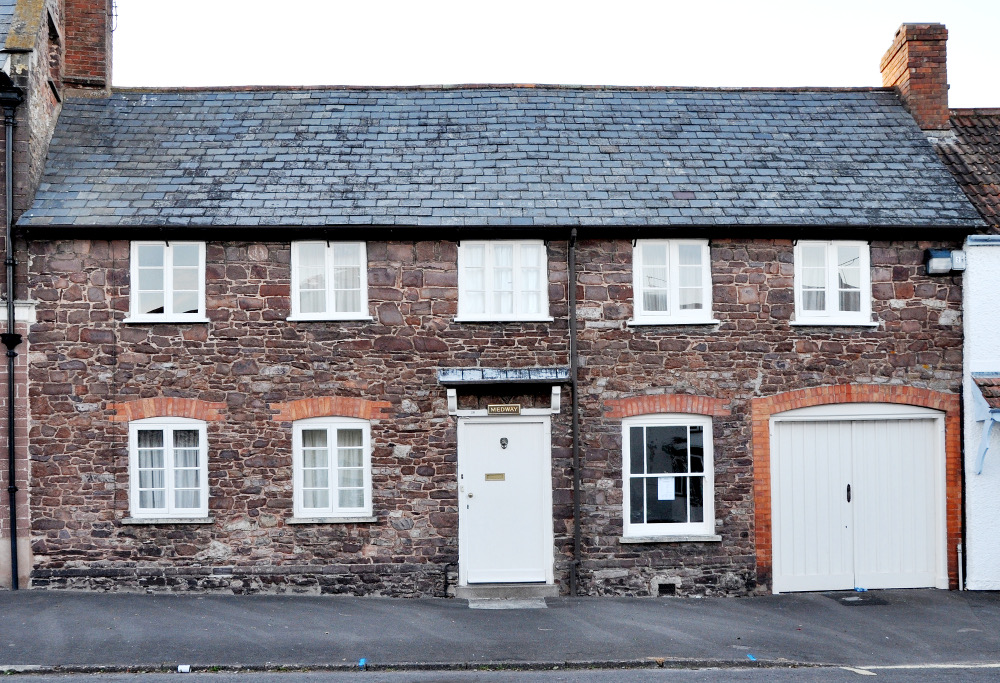
No 19 - Medway


Current

1897

Original?
....
This page is still under review, please come back to see possible future additions.
....
Coming up Castle street from the cross, on the north side of the road, the cottages were mainly of original vernacular style, but when we get to no19, this building was definitely of a different style and class.
No 19 - Medway
It was clearly 'designed', with the symmetry of fenestration:
central doorway and evenly balanced window layout. I suspect the
current right hand side was originally in line with the rest of the
building, but modified later in various stages.
There are a few clues we can find from old photos, but they also leave me with several questions
The design of the building would seem not to have changed much since the early 1900s, but before that things seem to happened.
The first obvious clues come from a photo dated around 1895, which shows it before the brick arched lintels. The first floor windows appear to be the old metal frames small pane construction. So there was obviously quite extensive alterations carried out after the 1895 photo. The angle of this photo is very oblique, so it is difficult to see the right hand end in detail.
There are a few clues we can find from old photos, but they also leave me with several questions
The design of the building would seem not to have changed much since the early 1900s, but before that things seem to happened.
The first obvious clues come from a photo dated around 1895, which shows it before the brick arched lintels. The first floor windows appear to be the old metal frames small pane construction. So there was obviously quite extensive alterations carried out after the 1895 photo. The angle of this photo is very oblique, so it is difficult to see the right hand end in detail.
Another photo shows a little more detail. This is actually a photo
of the celebrations for Queen Victoria's jubilee in 1897. This
building is on the right edge of the photo.
We can see that there was then a window directly below the right
hand end first floor window, and of the same size and style as those
on the left. However, there was still then the larger window
immediately to the right of the doorway, with a lower sill than the
others. I suspect that this was originally a window matching the
others, but enlarged at some time before the end of the 1800s,
perhaps as a display window for some business activity? There is
also, running off the edge of the photo, what appears to be a
possible doorway on the far right next to the end window; it looks
to be close to the window, so possibly just squeezed in at some
stage?
Looking at the current building, I think it is a nicely proportioned building with good quality random stonework and a slate roof.
However, I am curious when I look in more detail at the stonework.
Looking at the current building, I think it is a nicely proportioned building with good quality random stonework and a slate roof.
However, I am curious when I look in more detail at the stonework.
At first floor level, particularly between the windows, the
stonework is of large stones, whereas at ground floor level the
stones are mainly far smaller. This is unusual as one would expect
normally for the larger stones to be used at the lower level, with
the smaller stones used above - I wonder why it is as it seems here?
Could it even possibly have originally been single storey, with the upper storey added later?
The horizontal emphasis of the stonework at the transition between ground and first floor level might suggest that was the original roof line. However, this style of building was not your usual candidate for single storey, they were usually from much earlier, long before the 'designed' layout of doors and windows we see here. So, I'm a little baffled!
Of course, I may well be dramatically over-thinking this. Quite possibly, there is a simple explanation, like the later delivery of stone being larger ones than the earlier delivery; we will probably never know - still it helps to exercise the imagination!
How might the overall appearance have changed over the years?
Could it even possibly have originally been single storey, with the upper storey added later?
The horizontal emphasis of the stonework at the transition between ground and first floor level might suggest that was the original roof line. However, this style of building was not your usual candidate for single storey, they were usually from much earlier, long before the 'designed' layout of doors and windows we see here. So, I'm a little baffled!
Of course, I may well be dramatically over-thinking this. Quite possibly, there is a simple explanation, like the later delivery of stone being larger ones than the earlier delivery; we will probably never know - still it helps to exercise the imagination!
How might the overall appearance have changed over the years?
Current
1897
Original?
I think this would have been an important building from the time it
was built. With the quality of the stone and the well proportioned
design of the frontage, but without the overt grandeur of the
typical Georgian buildings, it would seem to be an nicely
understated quality building.
These are just my own thoughts and, of course, could be completely wrong. Anyone else reading this have any thoughts?
These are just my own thoughts and, of course, could be completely wrong. Anyone else reading this have any thoughts?
....
This page is still under review, please come back to see possible future additions.
....