

No 17
No.17 seems to have gone through a series of changes to become what we see today, although this is only evident thanks to some old photos.
No.17

The first distinguishing feature seen in old photos of No.17 is the small bay window which was evident in the earliest photo I have seen of around 1895. This photo also shows (just at the right hand edge of the photo) the ground floor window between the two doorways with its head at the same level as the top of the bay window at that time, this was much smaller than it was by the 1908 photo - also on the edge of the photo!


photos:1895 and 1908ish
We can see that some work took place between the two early photos - the bay window was changed, with fewer, larger panes and a deeper cill, and the small window between the two doorways was enlarged to match the first floor windows.
I suspect that, originally, the bay window did not exist and that there was simply a second small window like the other shown in the 1895 photo.
Why the bay window? Could this have been an earlier display window for a business or trade? The door next to it could have been the entrance to the business area, whereas the second doorway led into the domestic section? I wonder whether the right hand doorway was added later; it is very much up against the right hand end of the building so could have been 'squeezed' in for this purpose!
Although the early photos show the upstairs windows to be of a larger size, one would assume that they would have originally also been of a much smaller size like those of the original ground floor.
My guess would be that No.17, together with its two neighbouring cottages to the right (Nos.15 and 13) were all of a similar date and originally all of a similar vernacular style, probably with thatched roofs.
At some time before 1895, the thatched roofs were replaced with tiles, and presumably that would have been when the roof line of no.17 was raised and the larger first floor windows were installed? - all very much guesswork of course!

Photo approx 1909
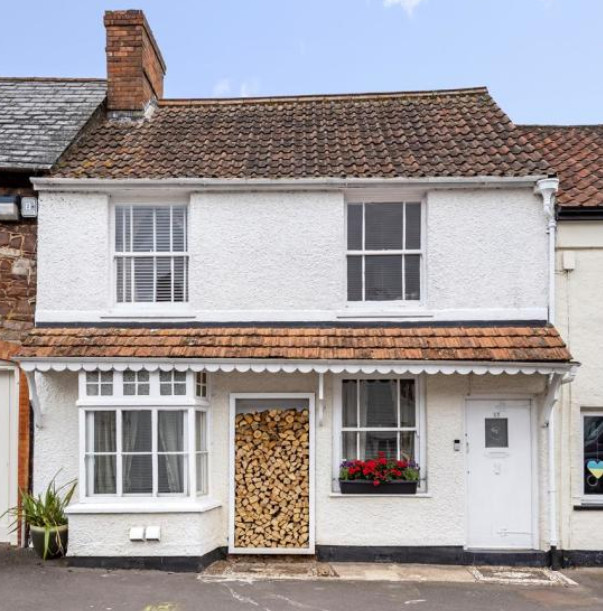
As far as I can see, the next change came perhaps in the 1920s or 1930s, when the bay window was given an extra fanlight section to bring it up to the height of the enlarged other ground floor window, and a roof canopy was fitted across the whole width of the building, as it still is today.


Photos around 1930 and 1940?
During recent 21st century renovations, No.17 has had the central (probably the original) doorway onto the street blocked up (the recess currently being used to store logs), leaving the right hand doorway as the one remaining access from Castle street. The earlier timber windows have been replaced with plastic, but they have thoughtfully retained the previous layout of glazing bars etc - but these, sadly, include 'false' glazing bars set within the double glazed units - such is progress, I suppose!

Before and after latest renovations
....
This page is still under review, please come back to see future additions.
....